MADE (Masked Autoencoder Density Estimation) implementation in PyTorch

Overview

pytorch-made

This code is an implementation of "Masked AutoEncoder for Density Estimation" by Germain et al., 2015. The core idea is that you can turn an auto-encoder into an autoregressive density model just by appropriately masking the connections in the MLP, ordering the input dimensions in some way and making sure that all outputs only depend on inputs earlier in the list. Like other autoregressive models (char-rnn, pixel cnns, etc), evaluating the likelihood is very cheap (a single forward pass), but sampling is linear in the number of dimensions.
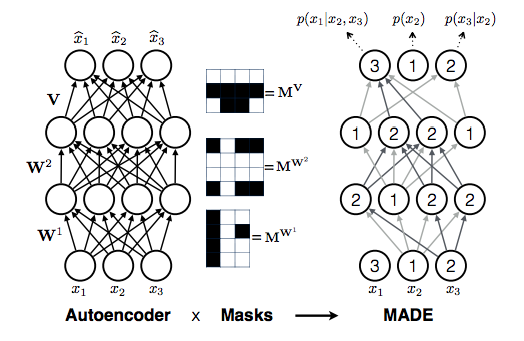
figure 1

The authors of the paper also published code here, but it's a bit wordy, sprawling and in Theano. Hence my own shot at it with only ~150 lines of code and PyTorch <3.

examples

First we download the binarized mnist dataset. Then we can reproduce the first point on the plot of Figure 2 by training a 1-layer MLP of 500 units with only a single mask, and using a single fixed (but random) ordering as so:

python run.py --data-path binarized_mnist.npz -q 500

which converges at binary cross entropy loss of 94.5, as shown in the paper. We can then simultaneously train a larger model ensemble (with weight sharing in the one MLP) and average over all of the models at test time. For instance, we can use 10 orderings (-n 10) and also average over the 10 at inference time (-s 10):

python run.py --data-path binarized_mnist.npz -q 500 -n 10 -s 10

which gives a much better test loss of 79.3, but at the cost of multiple forward passes. I was not able to reproduce single-forward-pass gains that the paper alludes to when training with multiple masks, might be doing something wrong.

usage

The core class is MADE, found in made.py. It inherits from PyTorch nn.Module so you can "slot it into" larger architectures quite easily. To instantiate MADE on 1D inputs of MNIST digits for example (which have 28*28 pixels), using one hidden layer of 500 neurons, and using a single but random ordering we would do:

model = MADE(28*28, [500], 28*28, num_masks=1, natural_ordering=False)

The reason we plug the size of the output (3rd argument) into MADE is that one might want to use relatively complicated output distributions, for example a gaussian distribution would normally be parameterized by a mean and a standard deviation for each dimension, or you could bin the output range into buckets and output logprobs for a softmax, or mixture parameters, etc. In the simplest example in this code we use binary predictions, where are only parameterized by one number, hence the number of the input dimensions happens to equal the number of outputs.

License

MIT

Owner
Andrej
I like to train Deep Neural Nets on large datasets.
Andrej
A PyTorch implementation of DenseNet.

A PyTorch Implementation of DenseNet This is a PyTorch implementation of the DenseNet-BC architecture as described in the paper Densely Connected Conv

Brandon Amos 771 Dec 15, 2022
Codes and pretrained weights for winning submission of 2021 Brain Tumor Segmentation (BraTS) Challenge

Winning submission to the 2021 Brain Tumor Segmentation Challenge This repo contains the codes and pretrained weights for the winning submission to th

94 Dec 28, 2022
An Empirical Investigation of Model-to-Model Distribution Shifts in Trained Convolutional Filters

CNN-Filter-DB An Empirical Investigation of Model-to-Model Distribution Shifts in Trained Convolutional Filters Paul Gavrikov, Janis Keuper Paper: htt

Paul Gavrikov 18 Dec 30, 2022
Implementation of gaze tracking and demo

Predicting Customer Demand by Using Gaze Detecting and Object Tracking This project is the integration of gaze detecting and object tracking. Predict

2 Oct 20, 2022
This repository is an unoffical PyTorch implementation of Medical segmentation in 3D and 2D.

Pytorch Medical Segmentation Read Chinese Introduction:Here! Recent Updates 2021.1.8 The train and test codes are released. 2021.2.6 A bug in dice was

EasyCV-Ellis 618 Dec 27, 2022
Implementation of ReSeg using PyTorch

Implementation of ReSeg using PyTorch ReSeg: A Recurrent Neural Network-based Model for Semantic Segmentation Pascal-Part Annotations Pascal VOC 2010

Onur Kaplan 46 Nov 23, 2022
Pytorch implementations of popular off-policy multi-agent reinforcement learning algorithms, including QMix, VDN, MADDPG, and MATD3.

Off-Policy Multi-Agent Reinforcement Learning (MARL) Algorithms This repository contains implementations of various off-policy multi-agent reinforceme

183 Dec 28, 2022
A static analysis library for computing graph representations of Python programs suitable for use with graph neural networks.

python_graphs This package is for computing graph representations of Python programs for machine learning applications. It includes the following modu

Google Research 258 Dec 29, 2022
🛠️ Tools for Transformers compression using Lightning ⚡

Bert-squeeze is a repository aiming to provide code to reduce the size of Transformer-based models or decrease their latency at inference time.

Jules Belveze 66 Dec 11, 2022
[CVPRW 2022] Attentions Help CNNs See Better: Attention-based Hybrid Image Quality Assessment Network

Attention Helps CNN See Better: Hybrid Image Quality Assessment Network [CVPRW 2022] Code for Hybrid Image Quality Assessment Network [paper] [code] T

IIGROUP 49 Dec 11, 2022
Train a state-of-the-art yolov3 object detector from scratch!

TrainYourOwnYOLO: Building a Custom Object Detector from Scratch This repo let's you train a custom image detector using the state-of-the-art YOLOv3 c

AntonMu 616 Jan 08, 2023
Official repository of the paper "GPR1200: A Benchmark for General-PurposeContent-Based Image Retrieval"

GPR1200 Dataset GPR1200: A Benchmark for General-Purpose Content-Based Image Retrieval (ArXiv) Konstantin Schall, Kai Uwe Barthel, Nico Hezel, Klaus J

Visual Computing Group 16 Nov 21, 2022
An implementation of DeepMind's Relational Recurrent Neural Networks in PyTorch.

relational-rnn-pytorch An implementation of DeepMind's Relational Recurrent Neural Networks (Santoro et al. 2018) in PyTorch. Relational Memory Core (

Sang-gil Lee 241 Nov 18, 2022
TakeInfoatNistforICS - Take Information in NIST NVD for ICS

Take Information in NIST NVD for ICS This project developed with Python. When yo

5 Sep 05, 2022
An elaborate and exhaustive paper list for Named Entity Recognition (NER)

Named-Entity-Recognition-NER-Papers by Pengfei Liu, Jinlan Fu and other contributors. An elaborate and exhaustive paper list for Named Entity Recognit

Pengfei Liu 388 Dec 18, 2022
Demo for Real-time RGBD-based Extended Body Pose Estimation paper

Real-time RGBD-based Extended Body Pose Estimation This repository is a real-time demo for our paper that was published at WACV 2021 conference The ou

Renat Bashirov 118 Dec 26, 2022
This is the code for CVPR 2021 oral paper: Jigsaw Clustering for Unsupervised Visual Representation Learning

JigsawClustering Jigsaw Clustering for Unsupervised Visual Representation Learning Pengguang Chen, Shu Liu, Jiaya Jia Introduction This project provid

DV Lab 73 Sep 18, 2022
UMT is a unified and flexible framework which can handle different input modality combinations, and output video moment retrieval and/or highlight detection results.

Unified Multi-modal Transformers This repository maintains the official implementation of the paper UMT: Unified Multi-modal Transformers for Joint Vi

Applied Research Center (ARC), Tencent PCG 84 Jan 04, 2023
Weakly-supervised semantic image segmentation with CNNs using point supervision

Code for our ECCV paper What's the Point: Semantic Segmentation with Point Supervision. Summary This library is a custom build of Caffe for semantic i

27 Sep 14, 2022
The official implementation of the CVPR2021 paper: Decoupled Dynamic Filter Networks

Decoupled Dynamic Filter Networks This repo is the official implementation of CVPR2021 paper: "Decoupled Dynamic Filter Networks". Introduction DDF is

F.S.Fire 180 Dec 30, 2022