An implementation of the AlphaZero algorithm for Gomoku (also called Gobang or Five in a Row)

Overview

AlphaZero-Gomoku

This is an implementation of the AlphaZero algorithm for playing the simple board game Gomoku (also called Gobang or Five in a Row) from pure self-play training. The game Gomoku is much simpler than Go or chess, so that we can focus on the training scheme of AlphaZero and obtain a pretty good AI model on a single PC in a few hours.

References:

  1. AlphaZero: Mastering Chess and Shogi by Self-Play with a General Reinforcement Learning Algorithm
  2. AlphaGo Zero: Mastering the game of Go without human knowledge

Update 2018.2.24: supports training with TensorFlow!

Update 2018.1.17: supports training with PyTorch!

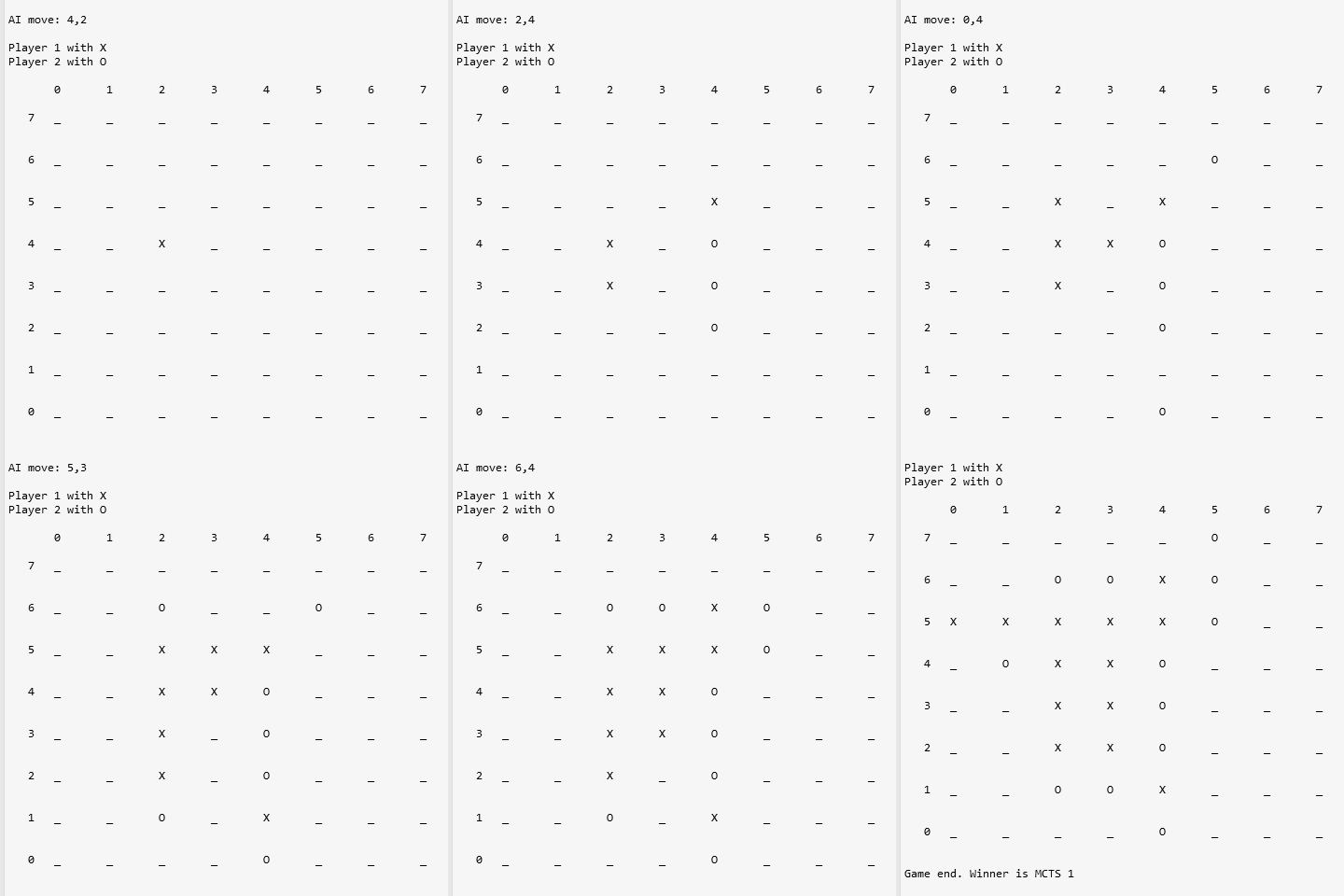
Example Games Between Trained Models

  • Each move with 400 MCTS playouts:
    playout400

Requirements

To play with the trained AI models, only need:

  • Python >= 2.7
  • Numpy >= 1.11

To train the AI model from scratch, further need, either:

  • Theano >= 0.7 and Lasagne >= 0.1
    or
  • PyTorch >= 0.2.0
    or
  • TensorFlow

PS: if your Theano's version > 0.7, please follow this issue to install Lasagne,
otherwise, force pip to downgrade Theano to 0.7 pip install --upgrade theano==0.7.0

If you would like to train the model using other DL frameworks, you only need to rewrite policy_value_net.py.

Getting Started

To play with provided models, run the following script from the directory:

python human_play.py  

You may modify human_play.py to try different provided models or the pure MCTS.

To train the AI model from scratch, with Theano and Lasagne, directly run:

python train.py

With PyTorch or TensorFlow, first modify the file train.py, i.e., comment the line

from policy_value_net import PolicyValueNet  # Theano and Lasagne

and uncomment the line

# from policy_value_net_pytorch import PolicyValueNet  # Pytorch
or
# from policy_value_net_tensorflow import PolicyValueNet # Tensorflow

and then execute: python train.py (To use GPU in PyTorch, set use_gpu=True and use return loss.item(), entropy.item() in function train_step in policy_value_net_pytorch.py if your pytorch version is greater than 0.5)

The models (best_policy.model and current_policy.model) will be saved every a few updates (default 50).

Note: the 4 provided models were trained using Theano/Lasagne, to use them with PyTorch, please refer to issue 5.

Tips for training:

  1. It is good to start with a 6 * 6 board and 4 in a row. For this case, we may obtain a reasonably good model within 500~1000 self-play games in about 2 hours.
  2. For the case of 8 * 8 board and 5 in a row, it may need 2000~3000 self-play games to get a good model, and it may take about 2 days on a single PC.

Further reading

My article describing some details about the implementation in Chinese: https://zhuanlan.zhihu.com/p/32089487

Owner
Junxiao Song
PhD, ECE, HKUST
Junxiao Song
Hand tracking demo for DIY Smart Glasses with a remote computer doing the work

CameraStream This is a demonstration that streams the image from smartglasses to a pc, does the hand recognition on the remote pc and streams the proc

Teemu Laurila 20 Oct 13, 2022
Retinal Vessel Segmentation with Pixel-wise Adaptive Filters (ISBI 2022)

Official code of Retinal Vessel Segmentation with Pixel-wise Adaptive Filters and Consistency Training (ISBI 2022)

anonymous 14 Oct 27, 2022
PyTorch Implementation of Region Similarity Representation Learning (ReSim)

ReSim This repository provides the PyTorch implementation of Region Similarity Representation Learning (ReSim) described in this paper: @Article{xiao2

Tete Xiao 74 Jan 03, 2023
A GUI to automatically create a TOPAS-readable MLC simulation file

Python script to create a TOPAS-readable simulation file descriring a Multi-Leaf-Collimator. Builds the MLC using the data from a 3D .stl file.

Sebastian Schäfer 0 Jun 19, 2022
PyTorch implementation for Stochastic Fine-grained Labeling of Multi-state Sign Glosses for Continuous Sign Language Recognition.

Stochastic CSLR This is the PyTorch implementation for the ECCV 2020 paper: Stochastic Fine-grained Labeling of Multi-state Sign Glosses for Continuou

Zhe Niu 28 Dec 19, 2022
Tensor-based approaches for fMRI classification

tensor-fmri Using tensor-based approaches to classify fMRI data from StarPLUS. Citation If you use any code in this repository, please cite the follow

4 Sep 07, 2022
Pytorch implementation for the EMNLP 2020 (Findings) paper: Connecting the Dots: A Knowledgeable Path Generator for Commonsense Question Answering

Path-Generator-QA This is a Pytorch implementation for the EMNLP 2020 (Findings) paper: Connecting the Dots: A Knowledgeable Path Generator for Common

Peifeng Wang 33 Dec 05, 2022
FairEdit: Preserving Fairness in Graph Neural Networks through Greedy Graph Editing

FairEdit Relevent Publication FairEdit: Preserving Fairness in Graph Neural Networks through Greedy Graph Editing

5 Feb 04, 2022
Split your patch similarly to `git add -p` but supporting multiple buckets

split-patch.py This is git add -p on steroids for patches. Given a my.patch you can run ./split-patch.py my.patch You can choose in which bucket to p

102 Oct 06, 2022
Semantic Bottleneck Scene Generation

SB-GAN Semantic Bottleneck Scene Generation Coupling the high-fidelity generation capabilities of label-conditional image synthesis methods with the f

Samaneh Azadi 41 Nov 28, 2022
[CVPR2021 Oral] UP-DETR: Unsupervised Pre-training for Object Detection with Transformers

UP-DETR: Unsupervised Pre-training for Object Detection with Transformers This is the official PyTorch implementation and models for UP-DETR paper: @a

dddzg 430 Dec 23, 2022
This framework implements the data poisoning method found in the paper Adversarial Examples Make Strong Poisons

Adversarial poison generation and evaluation. This framework implements the data poisoning method found in the paper Adversarial Examples Make Strong

31 Nov 01, 2022
Python script that takes an Impulse response .wav and a input .wav to demonstrate audio convolution.

convolver Python script that takes an Impulse response .wav and a input .wav to demonstrate audio convolution. Created by Sean Higley

Sean Higley 1 Feb 23, 2022
Official PyTorch implementation of "IntegralAction: Pose-driven Feature Integration for Robust Human Action Recognition in Videos", CVPRW 2021

IntegralAction: Pose-driven Feature Integration for Robust Human Action Recognition in Videos Introduction This repo is official PyTorch implementatio

Gyeongsik Moon 29 Sep 24, 2022
Expand human face editing via Global Direction of StyleCLIP, especially to maintain similarity during editing.

Oh-My-Face This project is based on StyleCLIP, RIFE, and encoder4editing, which aims to expand human face editing via Global Direction of StyleCLIP, e

AiLin Huang 51 Nov 17, 2022
《Rethinking Sptil Dimensions of Vision Trnsformers》(2021)

Rethinking Spatial Dimensions of Vision Transformers Byeongho Heo, Sangdoo Yun, Dongyoon Han, Sanghyuk Chun, Junsuk Choe, Seong Joon Oh | Paper NAVER

NAVER AI 224 Dec 27, 2022
LabelImg is a graphical image annotation tool.

LabelImgPlus LabelImg is a graphical image annotation tool. This project is not updated with new functions now. More functions are supported with Labe

lzx1413 200 Dec 20, 2022
Implement face detection, and age and gender classification, and emotion classification.

YOLO Keras Face Detection Implement Face detection, and Age and Gender Classification, and Emotion Classification. (image from wider face dataset) Ove

Chloe 10 Nov 14, 2022
MRI reconstruction (e.g., QSM) using deep learning methods

deepMRI: Deep learning methods for MRI Authors: Yang Gao, Hongfu Sun This repo is devloped based on Pytorch (1.8 or later) and matlab (R2019a or later

Hongfu Sun 17 Dec 18, 2022
TCube generates rich and fluent narratives that describes the characteristics, trends, and anomalies of any time-series data (domain-agnostic) using the transfer learning capabilities of PLMs.

TCube: Domain-Agnostic Neural Time series Narration This repository contains the code for the paper: "TCube: Domain-Agnostic Neural Time series Narrat

Mandar Sharma 7 Oct 31, 2021