DL & CV-based indicator toolset for the vehicle drivers via live dash-cam footage.

Overview

Vehicle Indicator Toolset

Deep Learning and Computer Vision based indicator toolset for vehicle drivers using live dash-cam footages.

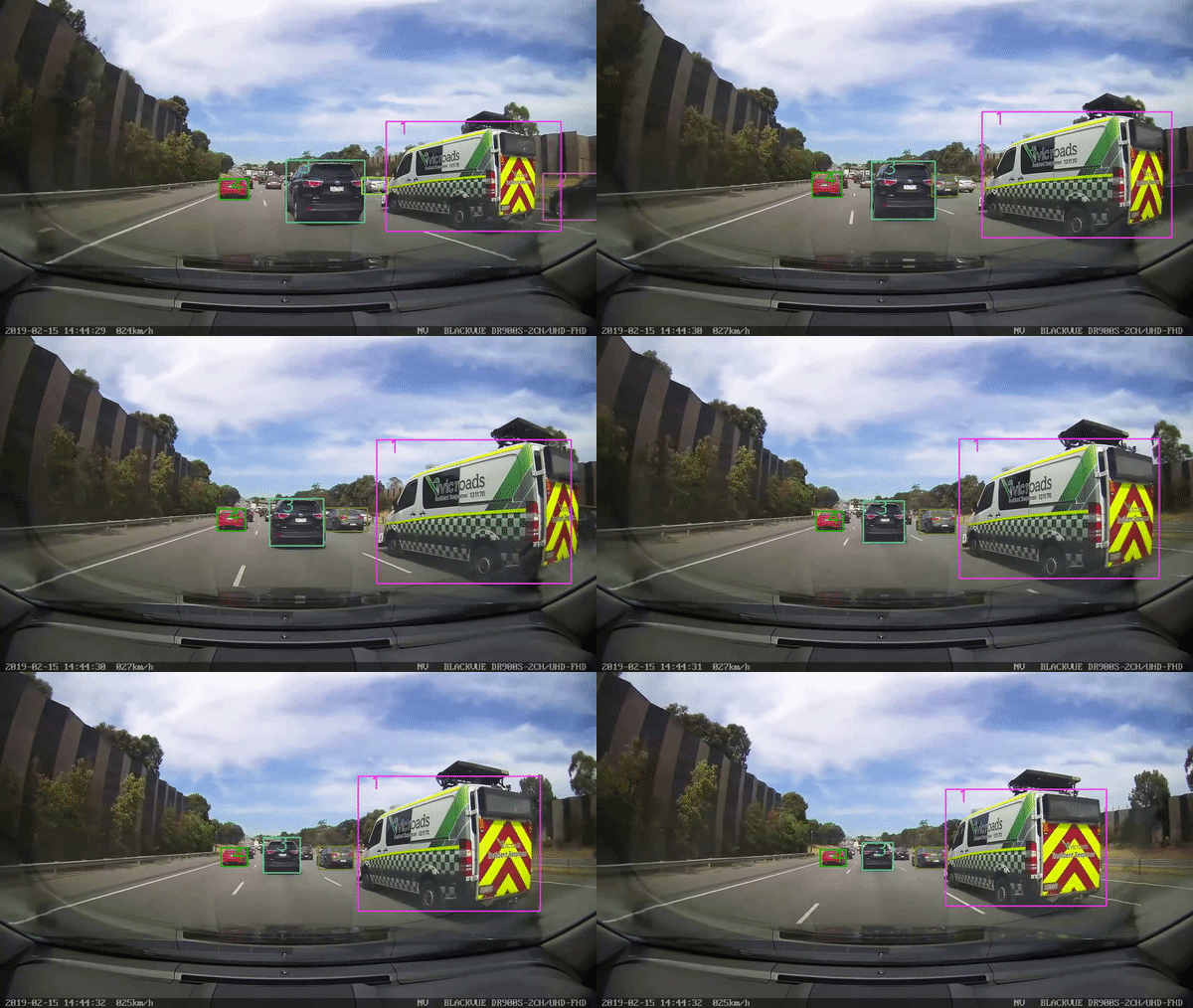
Tracking of vehicles
The tracking of the vehicles with a track ID can be seen below.

|


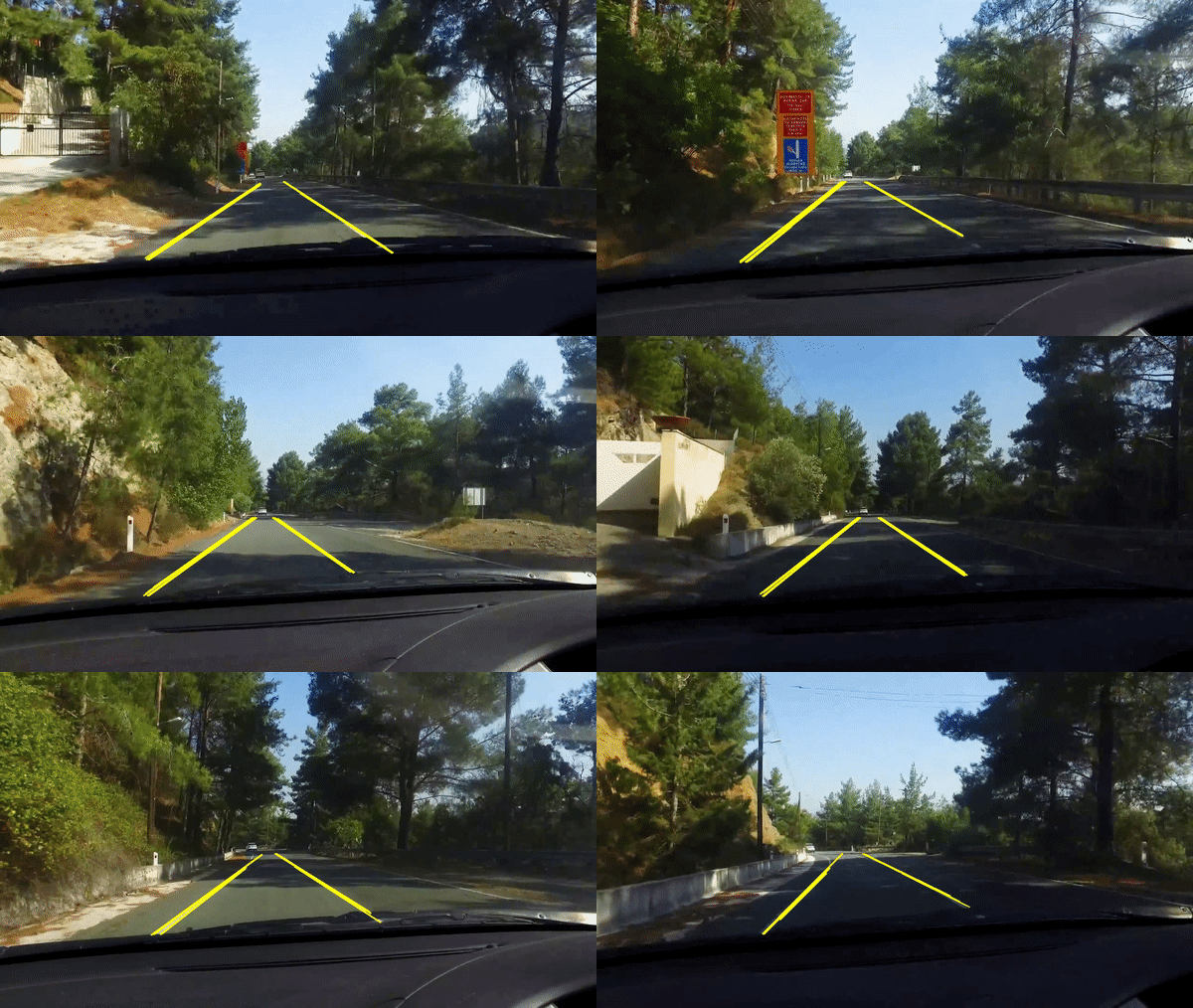
Detection of the lanes.
Whenever the driver gets out of the lane, he will be displayed a warning to stay inside the lane.
|


Tail light detection
Detect all the tail lights of the vehicles applying brakes at night.

|


Traffic signal recognition
Warning is shown when to stop and resume again using traffic lights.

|


Vehicle collision estimation
Incase, a collision is estimated, driver is warned.

|


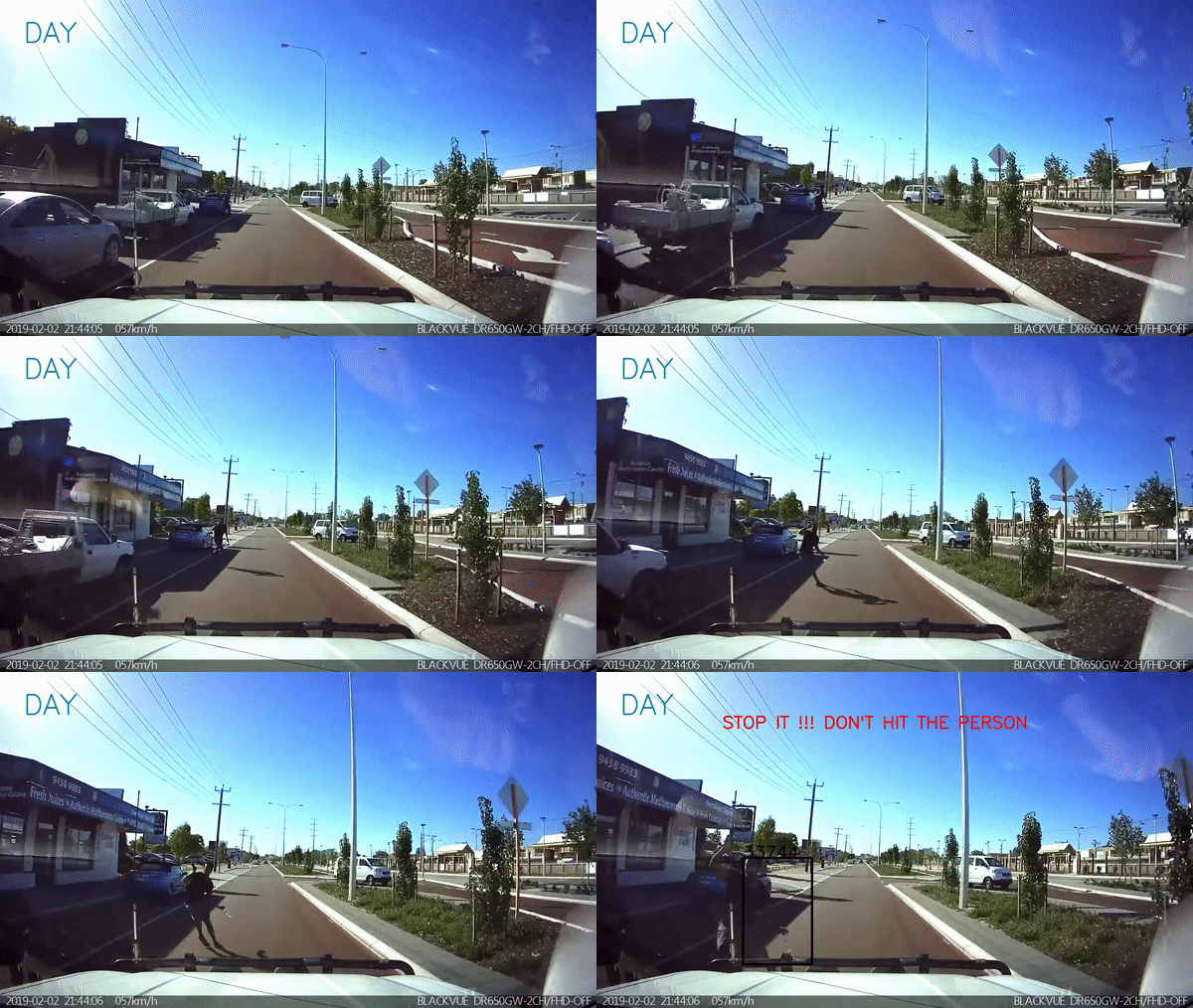
Pedestrian stepping
Whenever, pedestrian comes in our view, a warning is displayed.

|


Dependencies required:

  • Python 3.0
  • TensorFlow 2.0
  • openCV

Project Structure:

  • lanes:This folder contains files related to lane detection only.
  • tf-color: This folder contains files related to traffic light detection and detect the colour and accordingly give instructions to the driver.
  • tracked: This folder contains detection and tracking algorithm for the vehicles.
  • untracked: Detection and visualization only
  • utils: contains various functions that are used continuously again and again for different frames.
  • estimations: Detect pedestrians and vehicles too close to us that may cause collision.
  • cropping: Cropping frames using drag and drop or clicking points.
  • display: All the gifs shown above are stored here.

Requisities:

Download the tensorflow model from here.

  • Provide the path to the labels txt file using variable named PATH_TO_LABELS.
  • Provide the path to the tensorflow model using variable named model_name.
  • Make sure all the files are imported properly from the utils folder. If you get an error, add the location of the utils folder using sys module.
  • Tensorflow version 2.0 is must or else you may come across various error.

Working:

Run python integrate3.py or python intyolo.py after following the above mentioned requisities.
Now select the dash area for the car by clicking on multiple points as shown below. This is done to
remove detection of our own vehicle in some cases which may generate false results.

In the second step, select the area where searching of the lanes should be made. This may differ due to
the placement of dash-cams in the vehicle. The area above the horizon where road ends should not be selected.

Now, you can visualize the working and see the warnings/suggestions displayed to the driver.
All the works that are implemented individually are present in their respective folders, which are integrated together.
Old models may have some bugs now, as many files inside utils are changed.
Visit honors branch of models repository forked from tf/models to see more work on this project,
that I have done in google colab.

Drawbacks:

  • At night, searching for tail light should be made in the dark. If sufficient light is present, false cases can get introduced.
  • Tracking works good for bigger objects, while smaller may loose their track ID at places.
  • Threshold values used in lane detection needs to be altered depending on the roads and the quality of the videos.
  • Object detection needs to work properly for better results throughout. The model with higher accuracy should be downloaded from the link given above.
Owner
Alex Xu
Alex Xu
This repo contains the official code of our work SAM-SLR which won the CVPR 2021 Challenge on Large Scale Signer Independent Isolated Sign Language Recognition.

Skeleton Aware Multi-modal Sign Language Recognition By Songyao Jiang, Bin Sun, Lichen Wang, Yue Bai, Kunpeng Li and Yun Fu. Smile Lab @ Northeastern

Isen (Songyao Jiang) 128 Dec 08, 2022
CC-GENERATOR - A python script for generating CC

CC-GENERATOR A python script for generating CC NOTE: This tool is for Educationa

Lêkzï 6 Oct 14, 2022
Removing Inter-Experimental Variability from Functional Data in Systems Neuroscience

Removing Inter-Experimental Variability from Functional Data in Systems Neuroscience This repository is the official implementation of [https://www.bi

Eulerlab 6 Oct 09, 2022
NeuroMorph: Unsupervised Shape Interpolation and Correspondence in One Go

NeuroMorph: Unsupervised Shape Interpolation and Correspondence in One Go This repository provides our implementation of the CVPR 2021 paper NeuroMorp

Meta Research 35 Dec 08, 2022
Code for You Only Cut Once: Boosting Data Augmentation with a Single Cut

You Only Cut Once (YOCO) YOCO is a simple method/strategy of performing augmenta

88 Dec 28, 2022
Self-supervised learning on Graph Representation Learning (node-level task)

graph_SSL Self-supervised learning on Graph Representation Learning (node-level task) How to run the code To run GRACE, sh run_GRACE.sh To run GCA, sh

Namkyeong Lee 3 Dec 31, 2021
OpenDelta - An Open-Source Framework for Paramter Efficient Tuning.

OpenDelta is a toolkit for parameter efficient methods (we dub it as delta tuning), by which users could flexibly assign (or add) a small amount parameters to update while keeping the most paramters

THUNLP 386 Dec 26, 2022
An OpenAI Gym environment for Super Mario Bros

gym-super-mario-bros An OpenAI Gym environment for Super Mario Bros. & Super Mario Bros. 2 (Lost Levels) on The Nintendo Entertainment System (NES) us

Andrew Stelmach 1 Jan 05, 2022
N-HiTS: Neural Hierarchical Interpolation for Time Series Forecasting

N-HiTS: Neural Hierarchical Interpolation for Time Series Forecasting Recent progress in neural forecasting instigated significant improvements in the

Cristian Challu 82 Jan 04, 2023
Official PyTorch implementation of "Edge Rewiring Goes Neural: Boosting Network Resilience via Policy Gradient".

Edge Rewiring Goes Neural: Boosting Network Resilience via Policy Gradient This repository is the official PyTorch implementation of "Edge Rewiring Go

Shanchao Yang 4 Dec 12, 2022
Continuous Security Group Rule Change Detection & Response at scale

Introduction Get notified of Security Group Changes across all AWS Accounts & Regions in an AWS Organization, with the ability to respond/revert those

Raajhesh Kannaa Chidambaram 3 Aug 13, 2022
【Arxiv】Exploring Separable Attention for Multi-Contrast MR Image Super-Resolution

SANet Exploring Separable Attention for Multi-Contrast MR Image Super-Resolution Dependencies numpy==1.18.5 scikit_image==0.16.2 torchvision==0.8.1 to

36 Jan 05, 2023
Nsdf: A mesh SDF with just some code we can directly paste into our raymarcher

nsdf Representing SDFs of arbitrary meshes has been a bit tricky so far. Express

Jan Ivanecky 5 Feb 18, 2022
Revitalizing CNN Attention via Transformers in Self-Supervised Visual Representation Learning

Revitalizing CNN Attention via Transformers in Self-Supervised Visual Representation Learning

ChongjianGE 89 Dec 02, 2022
Backdoor Attack through Frequency Domain

Backdoor Attack through Frequency Domain DEPENDENCIES python==3.8.3 numpy==1.19.4 tensorflow==2.4.0 opencv==4.5.1 idx2numpy==1.2.3 pytorch==1.7.0 Data

5 Jun 18, 2022
Official Implementation for Fast Training of Neural Lumigraph Representations using Meta Learning.

Fast Training of Neural Lumigraph Representations using Meta Learning Project Page | Paper | Data Alexander W. Bergman, Petr Kellnhofer, Gordon Wetzst

Alex 39 Oct 08, 2022
Recursive Bayesian Networks

Recursive Bayesian Networks This repository contains the code to reproduce the results from the NeurIPS 2021 paper Lieck R, Rohrmeier M (2021) Recursi

Robert Lieck 11 Oct 18, 2022
Implementation for the paper SMPLicit: Topology-aware Generative Model for Clothed People (CVPR 2021)

SMPLicit: Topology-aware Generative Model for Clothed People [Project] [arXiv] License Software Copyright License for non-commercial scientific resear

Enric Corona 225 Dec 13, 2022
Negative Sample is Negative in Its Own Way: Tailoring Negative Sentences forImage-Text Retrieval

NSGDC Some codes in this repo are copied/modified from opensource implementations made available by UNITER, PyTorch, HuggingFace, OpenNMT, and Nvidia.

Zhihao Fan 2 Nov 07, 2022