Neural Radiance Fields Using PyTorch

Overview

Neural Radiance Fields Using PyTorch

NeRF (Neural Radiance Fields) is a method for achieving outcomes for synthesizing novel views of complex scenes. Posted below are a few videos generated by this project.

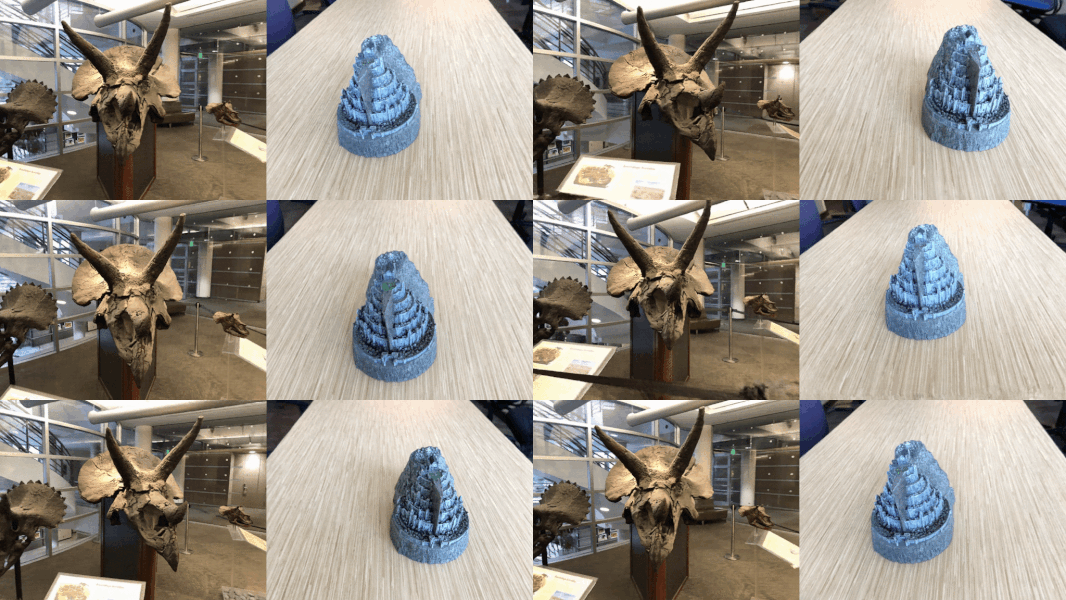
This project is a PyTorch implementation of NeRF that reproduces the results while running approximately 1.3x faster. The code is based on the TensorFlow implementation here of the author. PyTorch has been used for numerical testing and validation of the same.

Installation

git clone https://github.com/yenchenlin/nerf-pytorch.git
cd nerf-pytorch
pip install -r requirements.txt
cd torchsearchsorted
pip install .
cd ../
Dependencies (click to expand)

Dependencies

  • PyTorch 1.4
  • matplotlib
  • numpy
  • imageio
  • imageio-ffmpeg
  • configargparse

The LLFF data loader requires ImageMagick.

You will also need the LLFF code (and COLMAP) set up to compute poses if you want to run on your own real data.

How To Run?

Quick Start

Download data for two example datasets: lego and fern

bash download_example_data.sh

To train a low-res lego NeRF:

python run_nerf.py --config configs/config_lego.txt

After training for 100,000 iterations (~4 hours on a single 2080 Ti), you can find the following video at logs/lego_test/lego_test_spiral_100000_rgb.mp4.


To train a low-res fern NeRF:

python run_nerf.py --config configs/config_fern.txt

After training for 200k iterations (~8 hours on a single 2080 Ti), you can find the following video at logs/fern_test/fern_test_spiral_200000_rgb.mp4 and logs/fern_test/fern_test_spiral_200000_disp.mp4


More Datasets

To test out the other scenes presented in the paper, you can download the data here. Please place the downloaded dataset according to the following directory structure:

├── configs                                                                                                       
│   ├── ...                                                                                     
│                                                                                               
├── data                                                                                                                                                                                                       
│   ├── nerf_llff_data                                                                                                  
│   │   └── fern                                                                                                                             
│   │   └── flower  # downloaded llff dataset                                                                                  
│   │   └── horns   # downloaded llff dataset
|   |   └── ...
|   ├── nerf_synthetic
|   |   └── lego
|   |   └── ship    # downloaded synthetic dataset
|   |   └── ...

To train NeRF on different datasets:

python run_nerf.py --config configs/config_{DATASET}.txt

replace {DATASET} with trex | horns | flower | fortress | lego | etc.


To test NeRF trained on different datasets:

python run_nerf.py --config configs/config_{DATASET}.txt --render_only

replace {DATASET} with trex | horns | flower | fortress | lego | etc.

Pre-trained Models

You can download the pre-trained models here. Please place the downloaded directory in ./logs in order to test it later. Check the following directory structure for an example:

├── logs 
│   ├── fern_test
│   ├── flower_test  # downloaded logs
│   ├── trex_test    # downloaded logs

Reproducibility

The tests that ensure the results of all functions and training loop match the official implentation are contained in a different branch reproduce. One can check it out and run the tests:

git checkout reproduce
py.test

Method

NeRF: Representing Scenes as Neural Radiance Fields for View Synthesis
Ben Mildenhall*1, Pratul P. Srinivasan*1, Matthew Tancik*1, Jonathan T. Barron2, Ravi Ramamoorthi3, Ren Ng1
1UC Berkeley, 2Google Research, 3UC San Diego
*denotes equal contribution

A Neural Radiance Field is a simple fully connected network (weights are ~5MB) trained to reproduce input views of a single scene using a rendering loss. The network directly maps from spatial location and viewing direction (5D input) to color and opacity (4D output), acting as the "volume" so we can use volume rendering to differentiably render new views

Citation

A big thank-you to the authors (below) for their amazing work and results:

@misc{mildenhall2020nerf,
    title={NeRF: Representing Scenes as Neural Radiance Fields for View Synthesis},
    author={Ben Mildenhall and Pratul P. Srinivasan and Matthew Tancik and Jonathan T. Barron and Ravi Ramamoorthi and Ren Ng},
    year={2020},
    eprint={2003.08934},
    archivePrefix={arXiv},
    primaryClass={cs.CV}
}
Owner
Vedant Ghodke
Technical Undergraduate Intern At Cisco | Ex-AI Intern At Microsoft, India
Vedant Ghodke
Official pytorch implementation of paper "Image-to-image Translation via Hierarchical Style Disentanglement".

HiSD: Image-to-image Translation via Hierarchical Style Disentanglement Official pytorch implementation of paper "Image-to-image Translation

364 Dec 14, 2022
Implementation of BI-RADS-BERT & The Advantages of Section Tokenization.

BI-RADS BERT Implementation of BI-RADS-BERT & The Advantages of Section Tokenization. This implementation could be used on other radiology in house co

1 May 17, 2022
Official Implementation for HyperStyle: StyleGAN Inversion with HyperNetworks for Real Image Editing

HyperStyle: StyleGAN Inversion with HyperNetworks for Real Image Editing Yuval Alaluf*, Omer Tov*, Ron Mokady, Rinon Gal, Amit H. Bermano *Denotes equ

885 Jan 06, 2023
Code for "Learning Structural Edits via Incremental Tree Transformations" (ICLR'21)

Learning Structural Edits via Incremental Tree Transformations Code for "Learning Structural Edits via Incremental Tree Transformations" (ICLR'21) 1.

NeuLab 40 Dec 23, 2022
Neural models of common sense. 🤖

Unicorn on Rainbow Neural models of common sense. This repository is for the paper: Unicorn on Rainbow: A Universal Commonsense Reasoning Model on a N

AI2 60 Jan 05, 2023
Spectral Tensor Train Parameterization of Deep Learning Layers

Spectral Tensor Train Parameterization of Deep Learning Layers This repository is the official implementation of our AISTATS 2021 paper titled "Spectr

Anton Obukhov 12 Oct 23, 2022
The self-supervised goal reaching benchmark introduced in Discovering and Achieving Goals via World Models

Lexa-Benchmark Codebase for the self-supervised goal reaching benchmark introduced in 'Discovering and Achieving Goals via World Models'. Setup Create

1 Oct 14, 2021
PyTorch code for JEREX: Joint Entity-Level Relation Extractor

JEREX: "Joint Entity-Level Relation Extractor" PyTorch code for JEREX: "Joint Entity-Level Relation Extractor". For a description of the model and exp

LAVIS - NLP Working Group 50 Dec 01, 2022
VISNOTATE: An Opensource tool for Gaze-based Annotation of WSI Data

VISNOTATE: An Opensource tool for Gaze-based Annotation of WSI Data Introduction Requirements Installation and Setup Supported Hardware and Software R

SigmaLab 1 Jun 14, 2022
Pytorch implementation for A-NeRF: Articulated Neural Radiance Fields for Learning Human Shape, Appearance, and Pose

A-NeRF: Articulated Neural Radiance Fields for Learning Human Shape, Appearance, and Pose Paper | Website | Data A-NeRF: Articulated Neural Radiance F

Shih-Yang Su 172 Dec 22, 2022
A simple Neural Network that predicts the label for a series of handwritten digits

Neural_Network A simple Neural Network that predicts the label for a series of handwritten numbers This program tries to predict the label (1,2,3 etc.

Ty 1 Dec 18, 2021
An Straight Dilated Network with Wavelet for image Deblurring

SDWNet: A Straight Dilated Network with Wavelet Transformation for Image Deblurring(offical) 1. Introduction This repo is not only used for our paper(

FlyEgle 41 Jan 04, 2023
Auxiliary data to the CHIIR paper Searching to Learn with Instructional Scaffolding

Searching to Learn with Instructional Scaffolding This is the data and analysis code for the paper "Searching to Learn with Instructional Scaffolding"

Arthur Câmara 2 Mar 02, 2022
This is the official pytorch implementation of AutoDebias, an automatic debiasing method for recommendation.

AutoDebias This is the official pytorch implementation of AutoDebias, a debiasing method for recommendation system. AutoDebias is proposed in the pape

Dong Hande 77 Nov 25, 2022
Learning to Prompt for Vision-Language Models.

CoOp Paper: Learning to Prompt for Vision-Language Models Authors: Kaiyang Zhou, Jingkang Yang, Chen Change Loy, Ziwei Liu CoOp (Context Optimization)

Kaiyang 679 Jan 04, 2023
Unofficial PyTorch implementation of Neural Additive Models (NAM) by Agarwal, et al.

nam-pytorch Unofficial PyTorch implementation of Neural Additive Models (NAM) by Agarwal, et al. [abs, pdf] Installation You can access nam-pytorch vi

Rishabh Anand 11 Mar 14, 2022
It is a system used to detect bone fractures. using techniques deep learning and image processing

MohammedHussiengadalla-Intelligent-Classification-System-for-Bone-Fractures It is a system used to detect bone fractures. using techniques deep learni

Mohammed Hussien 7 Nov 11, 2022
Active window border replacement for window managers.

xborder Active window border replacement for window managers. Usage git clone https://github.com/deter0/xborder cd xborder chmod +x xborders ./xborder

deter 250 Dec 30, 2022
Bachelor's Thesis in Computer Science: Privacy-Preserving Federated Learning Applied to Decentralized Data

federated is the source code for the Bachelor's Thesis Privacy-Preserving Federated Learning Applied to Decentralized Data (Spring 2021, NTNU) Federat

Dilawar Mahmood 25 Nov 30, 2022
🍀 Pytorch implementation of various Attention Mechanisms, MLP, Re-parameter, Convolution, which is helpful to further understand papers.⭐⭐⭐

🍀 Pytorch implementation of various Attention Mechanisms, MLP, Re-parameter, Convolution, which is helpful to further understand papers.⭐⭐⭐

xmu-xiaoma66 7.7k Jan 05, 2023