ICON: Implicit Clothed humans Obtained from Normals

Related tags

Deep LearningICON
Overview

ICON: Implicit Clothed humans Obtained from Normals

Logo

arXiv, December 2021.
Yuliang Xiu · Jinlong Yang · Dimitrios Tzionas · Michael J. Black

Paper PDF Project Page


Table of Contents
  1. Who needs ICON
  2. More Qualitative Results
  3. Introduction Video
  4. Citation
  5. Acknowledgments
  6. Disclosure
  7. Contact


Who needs ICON?

  • If you want to reconstruct 3D clothed humans in unconstrained poses from in-the-wild images
    • together with the body under clothing (e.g. SMPL, SMPL-X)
    • clothed-body normal maps (front/back) predicted from images
All Intermedia Results
ICON's outputs from single RGB image
  • If you want to obtain a realistic and animatable 3D clothed avatar direclty from video / a sequence of monocular images
    • fully-textured with per-vertex color
    • could be animated by SMPL pose parameters
    • with pose-dependent clothing deformation
ICON+SCANimate+AIST++
3D Clothed Avatar, created from 400+ images using ICON+SCANimate, animated by AIST++


More Qualitative Results

Comparison
Comparison with other state-of-the-art methods
extreme
Reconstruction on in-the-wild photos with extreme poses (GIF)
extreme
Reconstruction on in-the-wild photos with extreme poses (PNG)
extreme
Predicted normals on in-the-wild images with extreme poses


Introduction Video

ICON.mp4


Citation

@misc{xiu2021icon,
      title={ICON: Implicit Clothed humans Obtained from Normals}, 
      author={Yuliang Xiu and Jinlong Yang and Dimitrios Tzionas and Michael J. Black},
      year={2021},
      eprint={2112.09127},
      archivePrefix={arXiv},
      primaryClass={cs.CV}
}

Acknowledgments

We thank Yao Feng, Soubhik Sanyal, Qianli Ma, Hongwei Yi, Chun-Hao Paul Huang, Weiyang Liu, and Xu Chen for their feedback and discussions, Tsvetelina Alexiadis for her help with the AMT perceptual study, Taylor McConnell for her voice over, and Yuanlu Xu's help in comparing with ARCH and ARCH++.

Here are some great resources we benefit from:

Some images used in the qualitative examples come from pinterest.com.

This project has received funding from the European Union’s Horizon 2020 research and innovation programme under the Marie Skłodowska-Curie grant agreement No.860768 (CLIPE Project).

Disclosure

MJB has received research gift funds from Adobe, Intel, Nvidia, Facebook, and Amazon. While MJB is a part-time employee of Amazon, his research was performed solely at, and funded solely by, Max Planck. MJB has financial interests in Amazon, Datagen Technologies, and Meshcapade GmbH.

Contact

For more questions, please contact [email protected]

Comments
  • OpenGL.raw.EGL._errors.EGLError: EGLError( )

    OpenGL.raw.EGL._errors.EGLError: EGLError( )

    When I run the command of "bash render_batch.sh debug", it gives an error as following

    OpenGL.raw.EGL._errors.EGLError: EGLError( err = EGL_NOT_INITIALIZED, baseOperation = eglInitialize, cArguments = ( <OpenGL._opaque.EGLDisplay_pointer object at 0x7f7b3d0ee2c0>, <importlib._bootstrap.LP_c_int object at 0x7f7b3d0ee440>, <importlib._bootstrap.LP_c_int object at 0x7f7b3d106bc0>, ), result = 0 )

    How can I fix this?

    documentation CUDA or OpenGL Dataset 
    opened by Yuhuoo 16
  • ConnectionError: HTTPSConnectionPool

    ConnectionError: HTTPSConnectionPool

    requests.exceptions.ConnectionError: HTTPSConnectionPool(host='drive.google.com', port=443): Max retries exceeded with url: /uc?id=1tCU5MM1LhRgGou5OpmpjBQbSrYIUoYab (Caused by NewConnectionError('<urllib3.connection.HTTPSConnection object at 0x7fbc4ad7deb0>: Failed to establish a new connection: [Errno 110] Connection timed out'))

    documentation rembg 
    opened by shuoshuoxu 12
  • Trouble getting ICON results

    Trouble getting ICON results

    After installing all packages, I got the results successfully for PIFu and PaMIR. I faced the runtime error when trying to get the ICON demo result. Could you guide what setting was wrong?

    $ python infer.py -cfg ../configs/icon-filter.yaml -gpu 0 -in_dir ../examples -out_dir ../results
    
    Traceback (most recent call last):
      File "infer.py", line 304, in <module>
        verts_pr, faces_pr, _ = model.test_single(in_tensor)
      File "./ICON/apps/ICON.py", line 738, in test_single
        sdf = self.reconEngine(opt=self.cfg,
      File "./.virtualenvs/icon/lib/python3.8/site-packages/torch/nn/modules/module.py", line 889, in _call_impl
        result = self.forward(*input, **kwargs)
      File "../lib/common/seg3d_lossless.py", line 148, in forward
        return self._forward_faster(**kwargs)
      File "../lib/common/seg3d_lossless.py", line 170, in _forward_faster
        occupancys = self.batch_eval(coords, **kwargs)
      File "../lib/common/seg3d_lossless.py", line 139, in batch_eval
        occupancys = self.query_func(**kwargs, points=coords2D)
      File "../lib/common/train_util.py", line 338, in query_func
        preds = netG.query(features=features,
      File "../lib/net/HGPIFuNet.py", line 285, in query
        smpl_sdf, smpl_norm, smpl_cmap, smpl_ind = cal_sdf_batch(
      File "../lib/dataset/mesh_util.py", line 231, in cal_sdf_batch
        residues, normals, pts_cmap, pts_ind = func(
      File "./.virtualenvs/icon/lib/python3.8/site-packages/torch/nn/modules/module.py", line 889, in _call_impl
        result = self.forward(*input, **kwargs)
      File "./.virtualenvs/icon/lib/python3.8/site-packages/bvh_distance_queries/mesh_distance.py", line 79, in forward
        output = self.search_tree(triangles, points)
      File "./.virtualenvs/icon/lib/python3.8/site-packages/torch/nn/modules/module.py", line 889, in _call_impl
        result = self.forward(*input, **kwargs)
      File "./.virtualenvs/icon/lib/python3.8/site-packages/torch/autograd/grad_mode.py", line 27, in decorate_context
        return func(*args, **kwargs)
      File "./.virtualenvs/icon/lib/python3.8/site-packages/bvh_distance_queries/bvh_search_tree.py", line 109, in forward
        output = BVHFunction.apply(
      File "./.virtualenvs/icon/lib/python3.8/site-packages/bvh_distance_queries/bvh_search_tree.py", line 42, in forward
        outputs = bvh_distance_queries_cuda.distance_queries(
    RuntimeError: after reduction step 1: cudaErrorInvalidDevice: invalid device ordinal
    
    CUDA or OpenGL 
    opened by Samiepapa 12
  • THuman Dataset preprocess

    THuman Dataset preprocess

    Hi, I found the program was running so slowly when I ran bash render_batch.sh debug all, I figured out it stopped at hits = mesh.ray.intersects_any (origins + delta * normals, vectors), and the number of rays is the millions, is that the reason why it was too slow?

    documentation Dataset 
    opened by mmmcn 11
  • Colab main cell doing nothing

    Colab main cell doing nothing

    Hi, first thanks for your code In colab version, when running the cell that starts with

    run the test on examples

    the execution is very fast, no errors, but do nothing. Next cell show errors: FileNotFoundError: [Errno 2] No such file or directory: '/content/ICON/results/icon-filter/vid/22097467bffc92d4a5c4246f7d4edb75_display.mp4'

    many thanks

    opened by smithee77 9
  • Error: undefined symbol: _ZNSt15__exception_ptr13exception_ptr10_M_releaseEv

    Error: undefined symbol: _ZNSt15__exception_ptr13exception_ptr10_M_releaseEv

    Getting this error when installing locally on my workstation via colab bash script.

    .../ICON/pytorch3d/pytorch3d/_C.cpython-38-x86_64-linux-gnu.so: undefined symbol: _ZNSt15__exception_ptr13exception_ptr10_M_releaseEv

    This after installing pytorch3d locally as recommended. Conda has too many conflicts and never resolves.

    Installing torch through pip works (1.8.2+cu111) up until the next steps of infer.py because bvh_distance_queries only supports cuda 11.0. This would most likely require compiling against 11.0, but it will probably lead to more errors as I don't know what this repository's dependencies require as far as torch goes.

    CUDA or OpenGL 
    opened by ExponentialML 9
  • The side face seems not good in training phase.

    The side face seems not good in training phase.

    I followed the instruction to process the THuman2.0 dataset and train the ICON. After 10 epochs, the result on tensorboard seems not good especially the reconstruction of the side face. I can't find where the problem is. image image

    The change of loss during training is

    微信图片_20221124141912

    opened by River-Zhang 7
  • Question for Reproducing Result

    Question for Reproducing Result

    Hi, I reproduced ICON and trained with THuman2.0.

    As a result of the my training, only this model produces a lot of noise and isolated mesh.

    Would you give me an advice?

    I used [-1, 1] SMPL vertices, query points, and 15.0 SDF clipping.

    I believe that ICON has great potential and generalization performance.

    But I don't know what is the problem.

    The results below are about unseen data, and I used pre-trained GCMR just like PaMIR for SMPL prediction.

    snapshot00 snapshot01 snapshot02 snapshot03 snapshot04 snapshot05

    Thank you.

    opened by EadCat 7
  • Problem about SMPL refining loss.

    Problem about SMPL refining loss.

    Many thanks to the author for his work. I found a question in the process of reading papers and code. The paper introduces in the Refining SMPL section that the results of SMPL modeling can be iteratively optimized during the inference process. The loss function includes two parts, the L1 difference between the unclothed normal map and the normal map of the model prediction results, and The L1 difference between the mask of the smpl normal map and the mask of the original image, but you did not implement the corresponding implementation in the code. What is the reason for this? Is the existing code implementation more efficient than the original implementation?

                # silhouette loss
                smpl_arr = torch.cat([T_mask_F, T_mask_B], dim=-1)[0]       # smpl mask maps
                gt_arr = torch.cat(                                         # clothed normal maps
                    [in_tensor['normal_F'][0], in_tensor['normal_B'][0]],
                    dim=2).permute(1, 2, 0)
                gt_arr = ((gt_arr + 1.0) * 0.5).to(device)
                bg_color = torch.Tensor([0.5, 0.5,
                                         0.5]).unsqueeze(0).unsqueeze(0).to(device)
                gt_arr = ((gt_arr - bg_color).sum(dim=-1) != 0.0).float()
                diff_S = torch.abs(smpl_arr - gt_arr)
                losses['silhouette']['value'] = diff_S.mean()
    
    HPS Discussion 
    opened by SongYupei 7
  • Some questions about training

    Some questions about training

    I would like to know some details about training. Is the Ground-Truth SMPL or the predicted SMPL used in training ICON? Also, what about normal images? According to my understanding of the paper and practice, ICON should train the normal network first and then train the implicit reconstruction network. When I reproduce ICON, I don't know whether to choose the Ground-Truth or the predicted data for SMPL model and normal images, respectively.

    Dataset Training 
    opened by sunjc0306 7
  • ModuleNotFoundError: No module named 'bvh_distance_queries_cuda'

    ModuleNotFoundError: No module named 'bvh_distance_queries_cuda'

    Hi, thank you so much for the wonderful work and corresponding codes. I am facing the following issue: https://github.com/YuliangXiu/ICON/blob/0045bd10f076bf367d25b7dac41d0d5887b8694f/lib/bvh-distance-queries/bvh_distance_queries/bvh_search_tree.py#L27

    Is there any .py file called bvh_distance_queries_cuda ? Please let me know a possible solution. Thank you for your effort and help :) :) :)

    CUDA or OpenGL 
    opened by Pallab38 7
  • Question about training

    Question about training

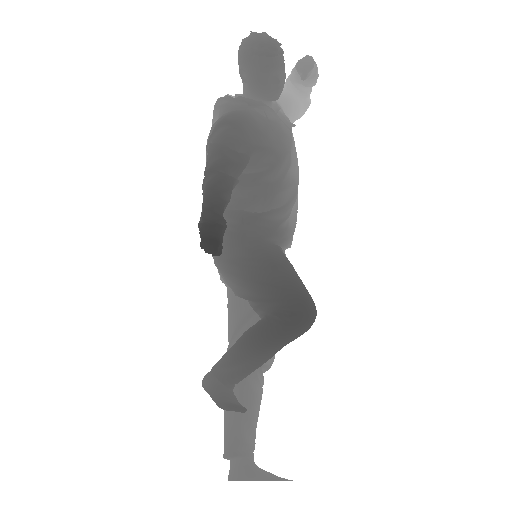
    After training of the implicit MLP, I got quite wired results. The reconstructed meshes are poor. 0_nc The evaluation results shows that NC is very low, but chamfer and p2s are very high. eval Do you know where the problem is? I would appreciate it a lot if you could give me some suggestions!
    opened by Zhangjzh 4
  • Question of  cloth refinement

    Question of cloth refinement

    Hi, I'm confused about local_affine_model in the cloth refinement. I find that you use the LocalAffine() converting the verts of the refinemesh to the affined verts. The step seems to train a Affinemodel. I know that we need get the loss between P_normal from the mesh and normal of the image to optimizer the verts, but I don't understand why we need introduct the Affinemodel. The procedure of localAffine is meaning getting the Affine Matrix under the Camera coordinate system? I confused about these.

    opened by Yuhuoo 1
  • Can't setup ICON on Ubuntu / Colab

    Can't setup ICON on Ubuntu / Colab

    Unfortunately, I can't manage to install ICON locally. The Colab Notebook and the model on Huggingface also seem to be broken. Would it be possible to update the documentation / environment or share a Docker file?

    opened by c6s0 4
  • how to get real depth value from depth map

    how to get real depth value from depth map

    Hi, recently I've been trying to use depth map as prior information, but how can I generate the point cloud at camera coordinate space or model space from the given depth map(generated by render_single.py) ? For example, how can i generate point cloud in camera/view space by depth_F/xxx.png below, i.e. how can i get the real depth value in camera space. I tried to see the coordinate transformation in the code, it seems that I can get perspective matrix and model_view matrix in lib/render/camer.py , which may transform the model from local space into clip space. But I am still confused about how to convert the depth map to another space.

    It would be very appricated if anyone could give me some advice!

    opened by mmmcn 2
  • scripts/render_single.sh: line 33: 137550 Killed

    scripts/render_single.sh: line 33: 137550 Killed

    ubuntu 22.04 + NVIDIA 2080Ti.

    I encountered this error when execute this script "bash scripts/render_batch.sh debug all".

    thuman2 START----------
    Debug renderer
    Rendering thuman2 0001
    /home/hcp/anaconda3/envs/metaverse/lib/python3.8/site-packages/scipy/__init__.py:146: UserWarning: A NumPy version >=1.16.5 and <1.23.0 is required for this version of SciPy (detected version 1.23.3
      warnings.warn(f"A NumPy version >={np_minversion} and <{np_maxversion}"
    
    **scripts/render_single.sh: line 33: 137550 Killed                  python $PYTHON_SCRIPT -s $SUBJECT -o $SAVE_DIR -r $NUM_VIEWS -w $SIZE**
    thuman2 END----------
    
    opened by hcp6897 1
  • A weird bug: The data is not on the same device.

    A weird bug: The data is not on the same device.

    https://github.com/YuliangXiu/ICON/blob/ece5a09aa2d56aec28017430e65a0352622a0f30/lib/dataset/mesh_util.py#L283

    ` print(triangles.device) # cuda:1

    print(points.device) # cuda:1

    residues, pts_ind, _ = point_to_mesh_distance(points, triangles)

    print(triangles.device) # cuda:1

    print(pts_ind.device) # cuda:0

    print(residues.device) # cuda:0`

    command: python -m apps.infer -cfg ./configs/icon-filter.yaml -gpu 1 -in_dir {*} -out_dir {*} 'CUDA_VISIBLE_DEVICES=1' doesn't work either.

    CUDA or OpenGL 
    opened by caiyongqi 11
Releases(v.1.1.0)
  • v.1.1.0(Aug 5, 2022)

    Important updates:

    • Support normal network training
    • New interactive demo deployed on HuggingFace space
    • Faster Google Colab environment setup
    • Improved clothing refinement module
    • Fix several bugs and refactor some messy functions
    Source code(tar.gz)
    Source code(zip)
  • v.1.0.0(Jun 15, 2022)

    The first stable version (ICON v.1.0.0) comes out!

    • Dataset: support THuman2.0
    • Inference: support PyMAF, PIXIE, PARE, HybrIK, BEV
    • Training & Evaluation: support PIFu, PaMIR, ICON
    • Add-on: garment extraction from fashion images
    Source code(tar.gz)
    Source code(zip)
  • v.1.0.0-rc2(Mar 7, 2022)

    Some updates:

    • HPS support: PyMAF (SMPL), PARE (SMPL), PIXIE (SMPL-X)
    • Google Colab support
    • Replace bvh-distance-queries with PyTorch3D and Kaolin to improve CUDA compatibility
    • Fix some issues
    Source code(tar.gz)
    Source code(zip)
  • v.1.0.0-rc1(Jan 30, 2022)

    First commit of ICON:

    • image-based inference code
    • pretrained model of ICON, PIFu*, PaMIR* (*: self-implementation)
    • homepage: https://icon.is.tue.mpg.de
    Source code(tar.gz)
    Source code(zip)
Owner
Yuliang Xiu
Ph.D. Student in Graphics & Vision
Yuliang Xiu
ALFRED - A Benchmark for Interpreting Grounded Instructions for Everyday Tasks

ALFRED A Benchmark for Interpreting Grounded Instructions for Everyday Tasks Mohit Shridhar, Jesse Thomason, Daniel Gordon, Yonatan Bisk, Winson Han,

ALFRED 204 Dec 15, 2022
DataCLUE: 国内首个以数据为中心的AI测评(含模型分析报告)

DataCLUE: A Benchmark Suite for Data-centric NLP You can get the english version of README. 以数据为中心的AI测评(DataCLUE) 内容导引 章节 描述 简介 介绍以数据为中心的AI测评(DataCLUE

CLUE benchmark 135 Dec 22, 2022
Compare outputs between layers written in Tensorflow and layers written in Pytorch

Compare outputs of Wasserstein GANs between TensorFlow vs Pytorch This is our testing module for the implementation of improved WGAN in Pytorch Prereq

Hung Nguyen 72 Dec 20, 2022
Implementation of " SESS: Self-Ensembling Semi-Supervised 3D Object Detection" (CVPR2020 Oral)

SESS: Self-Ensembling Semi-Supervised 3D Object Detection Created by Na Zhao from National University of Singapore Introduction This repository contai

125 Dec 23, 2022
U-2-Net: U Square Net - Modified for paired image training of style transfer

U2-Net: U Square Net Modified for paired image training of style transfer This is an unofficial repo making use of the code which was made available b

Doron Adler 43 Oct 03, 2022
TransZero++: Cross Attribute-guided Transformer for Zero-Shot Learning

TransZero++ This repository contains the testing code for the paper "TransZero++: Cross Attribute-guided Transformer for Zero-Shot Learning" submitted

Shiming Chen 6 Aug 16, 2022
A simple code to perform canny edge contrast detection on images.

CECED-Canny-Edge-Contrast-Enhanced-Detection A simple code to perform canny edge contrast detection on images. A simple code to process images using c

Happy N. Monday 3 Feb 15, 2022
An excellent hash algorithm combining classical sponge structure and RNN.

SHA-RNN Recurrent Neural Network with Chaotic System for Hash Functions Anonymous Authors [摘要] 在这次作业中我们提出了一种新的 Hash Function —— SHA-RNN。其以海绵结构为基础,融合了混

Houde Qian 5 May 15, 2022
Extracting knowledge graphs from language models as a diagnostic benchmark of model performance.

Interpreting Language Models Through Knowledge Graph Extraction Idea: How do we interpret what a language model learns at various stages of training?

EPFL Machine Learning and Optimization Laboratory 9 Oct 25, 2022
An NLP library with Awesome pre-trained Transformer models and easy-to-use interface, supporting wide-range of NLP tasks from research to industrial applications.

简体中文 | English News [2021-10-12] PaddleNLP 2.1版本已发布!新增开箱即用的NLP任务能力、Prompt Tuning应用示例与生成任务的高性能推理! 🎉 更多详细升级信息请查看Release Note。 [2021-08-22]《千言:面向事实一致性的生

6.9k Jan 01, 2023
for a paper about leveraging discourse markers for training new models

TSLM-DISCOURSE-MARKERS Scope This repository contains: (1) Code to extract discourse markers from wikipedia (TSA). (1) Code to extract significant dis

International Business Machines 6 Nov 02, 2022
TensorFlow implementation of Elastic Weight Consolidation

Elastic weight consolidation Introduction A TensorFlow implementation of elastic weight consolidation as presented in Overcoming catastrophic forgetti

James Stokes 67 Oct 11, 2022
Finite-temperature variational Monte Carlo calculation of uniform electron gas using neural canonical transformation.

CoulombGas This code implements the neural canonical transformation approach to the thermodynamic properties of uniform electron gas. Building on JAX,

FermiFlow 9 Mar 03, 2022
Official implementation for “Unsupervised Low-Light Image Enhancement via Histogram Equalization Prior”

HEP Unsupervised Low-Light Image Enhancement via Histogram Equalization Prior Implementation Python3 PyTorch=1.0 NVIDIA GPU+CUDA Training process The

FengZhang 34 Dec 04, 2022
Multi-Stage Episodic Control for Strategic Exploration in Text Games

XTX: eXploit - Then - eXplore Requirements First clone this repo using git clone https://github.com/princeton-nlp/XTX.git Please create two conda envi

Princeton Natural Language Processing 9 May 24, 2022
A fast implementation of bss_eval metrics for blind source separation

fast_bss_eval Do you have a zillion BSS audio files to process and it is taking days ? Is your simulation never ending ? Fear no more! fast_bss_eval i

Robin Scheibler 99 Dec 13, 2022
Block Sparse movement pruning

Movement Pruning: Adaptive Sparsity by Fine-Tuning Magnitude pruning is a widely used strategy for reducing model size in pure supervised learning; ho

Hugging Face 54 Dec 20, 2022
This repository includes the code of the sequence-to-sequence model for discontinuous constituent parsing described in paper Discontinuous Grammar as a Foreign Language.

Discontinuous Grammar as a Foreign Language This repository includes the code of the sequence-to-sequence model for discontinuous constituent parsing

Daniel Fernández-González 2 Apr 07, 2022
A big endian Gentoo port developed on a Pine64.org RockPro64

Gentoo-aarch64_be A big endian Gentoo port developed on a Pine64.org RockPro64 The endian wars are over... little endian won. As a result, it is incre

Rory Bolt 6 Dec 07, 2022
This repository contains the database and code used in the paper Embedding Arithmetic for Text-driven Image Transformation

This repository contains the database and code used in the paper Embedding Arithmetic for Text-driven Image Transformation (Guillaume Couairon, Holger

Meta Research 31 Oct 17, 2022