Efficient and Scalable Physics-Informed Deep Learning and Scientific Machine Learning on top of Tensorflow for multi-worker distributed computing

Overview

TensorDiffEq logo

Package Build Package Release pypi downloads python versions

Notice: Support for Python 3.6 will be dropped in v.0.2.1, please plan accordingly!

Efficient and Scalable Physics-Informed Deep Learning

Collocation-based PINN PDE solvers for prediction and discovery methods on top of Tensorflow 2.X for multi-worker distributed computing.

Use TensorDiffEq if you require:

  • A meshless PINN solver that can distribute over multiple workers (GPUs) for forward problems (inference) and inverse problems (discovery)
  • Scalable domains - Iterated solver construction allows for N-D spatio-temporal support
    • support for N-D spatial domains with no time element is included
  • Self-Adaptive Collocation methods for forward and inverse PINNs
  • Intuitive user interface allowing for explicit definitions of variable domains, boundary conditions, initial conditions, and strong-form PDEs

What makes TensorDiffEq different?

  • Completely open-source

  • Self-Adaptive Solvers for forward and inverse problems, leading to increased accuracy of the solution and stability in training, resulting in less overall training time

  • Multi-GPU distributed training for large or fine-grain spatio-temporal domains

  • Built on top of Tensorflow 2.0 for increased support in new functionality exclusive to recent TF releases, such as XLA support, autograph for efficent graph-building, and grappler support for graph optimization* - with no chance of the source code being sunset in a further Tensorflow version release

  • Intuitive interface - defining domains, BCs, ICs, and strong-form PDEs in "plain english"

*In development

If you use TensorDiffEq in your work, please cite it via:

@article{mcclenny2021tensordiffeq,
  title={TensorDiffEq: Scalable Multi-GPU Forward and Inverse Solvers for Physics Informed Neural Networks},
  author={McClenny, Levi D and Haile, Mulugeta A and Braga-Neto, Ulisses M},
  journal={arXiv preprint arXiv:2103.16034},
  year={2021}
}

Thanks to our additional contributors:

@marcelodallaqua, @ragusa, @emiliocoutinho

Comments
  • Latest version of package

    Latest version of package

    The examples in the doc use the latest code of master branch but the library on Pypi is still the version in May. Can you build the lib and update the version on Pypi?

    opened by devzhk 5
  • ADAM training on batches

    ADAM training on batches

    It is possible to define a batch size and this will be applied to the calculation of the residual loss function, in splitting the collocation points in batches during the training.

    opened by emiliocoutinho 3
  • Pull Request using PyCharm

    Pull Request using PyCharm

    Dear Levi,

    I tried to make a Pull Request on this repository using PyCharm, and I received the following message:

    Although you appear to have the correct authorization credentials, the tensordiffeq organization has enabled OAuth App access restrictions, meaning that data access to third-parties is limited. For more information on these restrictions, including how to whitelist this app, visit https://help.github.com/articles/restricting-access-to-your-organization-s-data/

    I would kindly ask you to authorize PyCharm to access your organization data to use the GUI to make future pull requests.

    Best Regards

    opened by emiliocoutinho 1
  • Update method def get_sizes of utils.py

    Update method def get_sizes of utils.py

    Fix bug on the method def get_sizes(layer_sizes) of utils.py. The method was only allowing neural nets with an identical number of nodes in each hidden layer. Which was making the L- BFGS optimization to crash.

    opened by marcelodallaqua 1
  • model.save ?

    model.save ?

    Sometimes, it's useful to save the model for later use. I couldn't find a .save method and pickle (and dill) didn't let me dump the object for later re-use. (example of error with pickle: Can't pickle local object 'make_gradient_clipnorm_fn..').

    Is it currently possible to save the model? Thanks!

    opened by ragusa 1
  • add model.save and model.load_model

    add model.save and model.load_model

    Add model.save and model.load_model to CollocationSolverND class ref #3

    Will be released in the next stable.

    currently this can be done by using the Keras integration via running model.u_model.save("path/to/file"). This change will allow a direct save by calling model.save() on the CollocationSolverND class. Same with load_model().

    The docs will be updated to reflect this change.

    opened by levimcclenny 0
  • 2D Burgers Equation

    2D Burgers Equation

    Hello @levimcclenny and thanks for recommending this library!

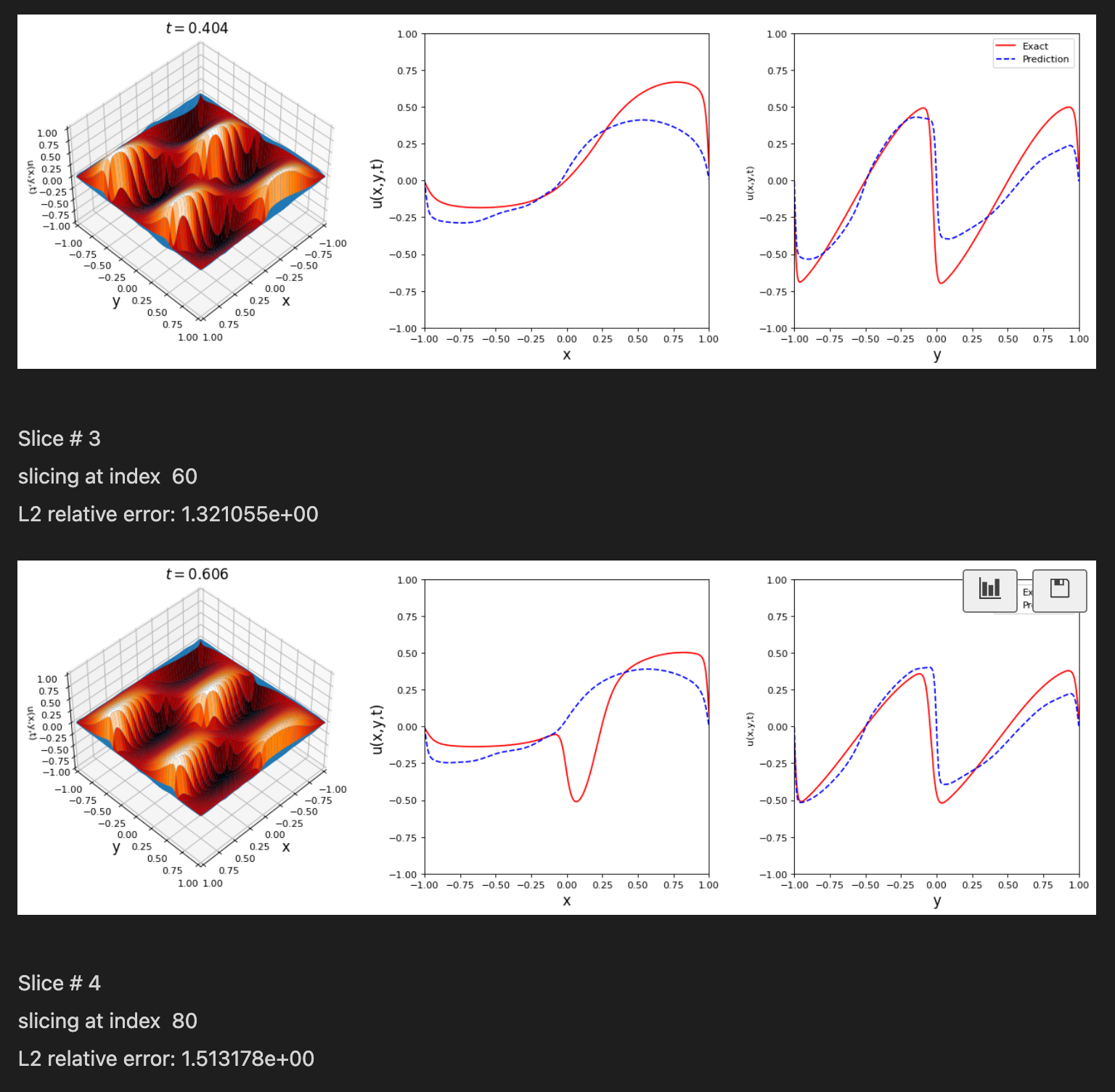
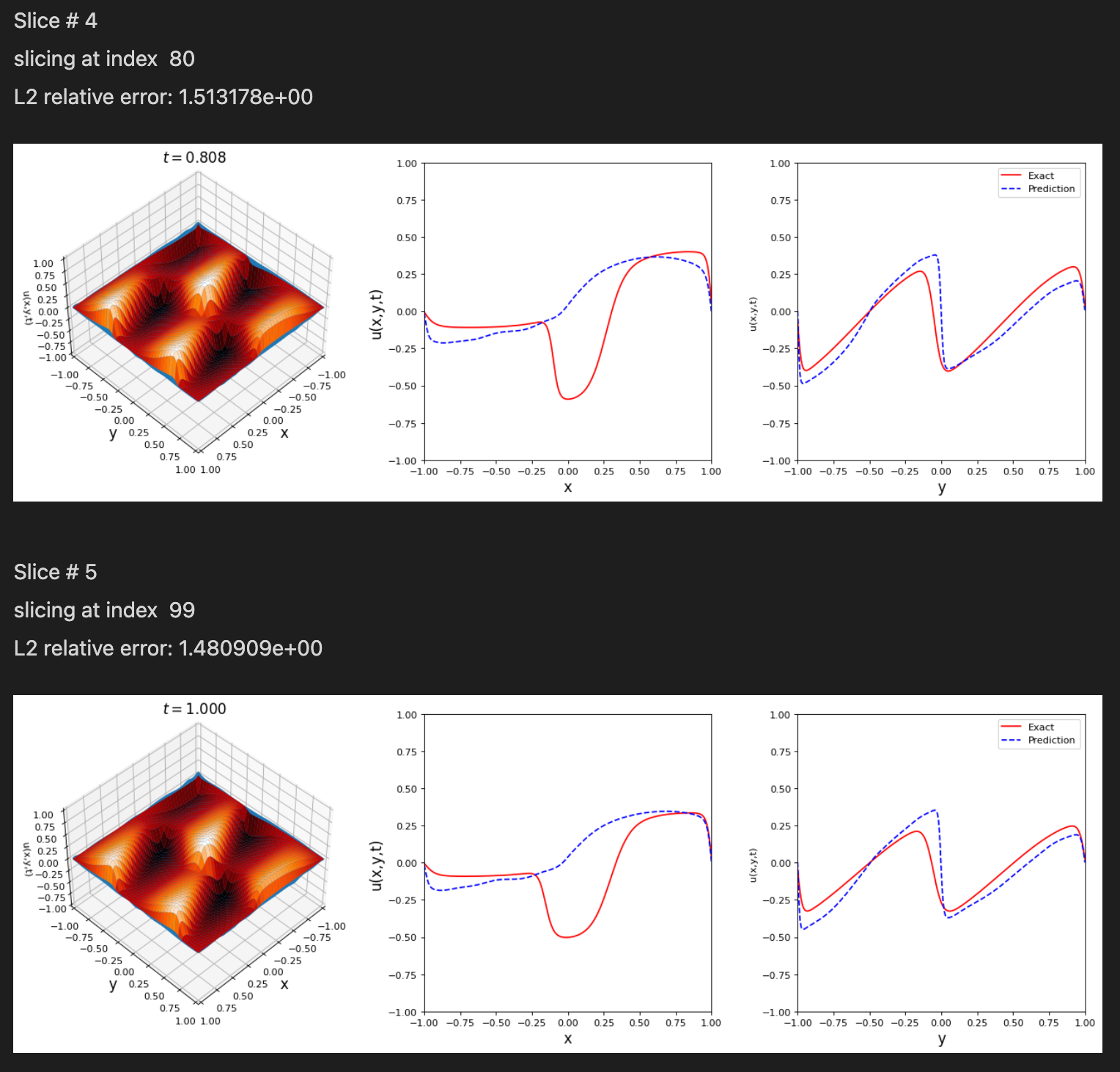
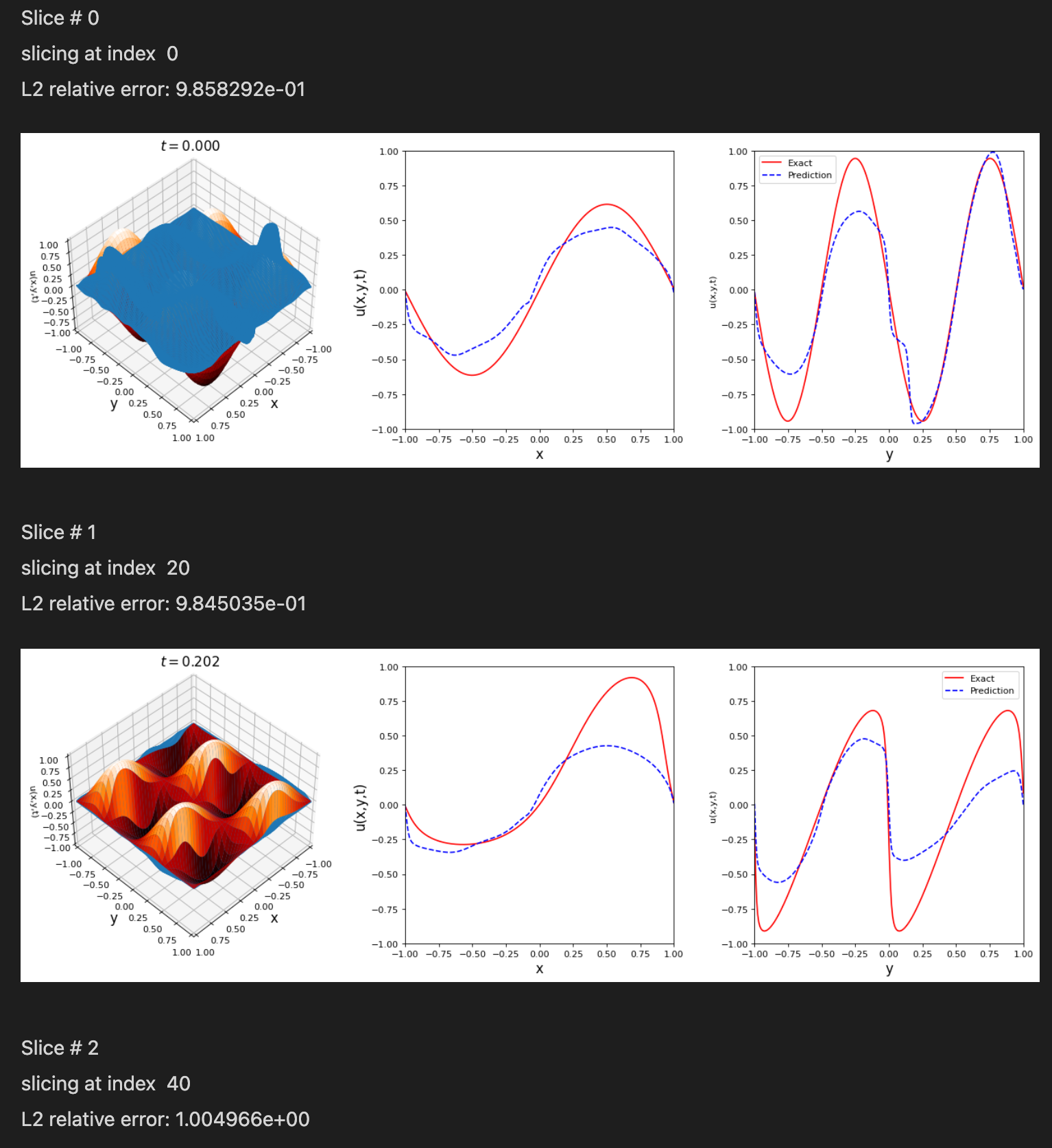
    I have modified the 1D burger example to be in 2D, but I did not get good comparison results. Any suggestions?

    import math
    import scipy.io
    import tensordiffeq as tdq
    from tensordiffeq.boundaries import *
    from tensordiffeq.models import CollocationSolverND
    
    Domain = DomainND(["x", "y", "t"], time_var='t')
    
    Domain.add("x", [-1.0, 1.0], 256)
    Domain.add("y", [-1.0, 1.0], 256)
    Domain.add("t", [0.0, 1.0], 100)
    
    N_f = 10000
    Domain.generate_collocation_points(N_f)
    
    
    def func_ic(x,y):
        p =2
        q =1
        return np.sin (p * math.pi * x) * np.sin(q * math.pi * y)
        
    
    init = IC(Domain, [func_ic], var=[['x','y']])
    upper_x = dirichletBC(Domain, val=0.0, var='x', target="upper")
    lower_x = dirichletBC(Domain, val=0.0, var='x', target="lower")
    upper_y = dirichletBC(Domain, val=0.0, var='y', target="upper")
    lower_y = dirichletBC(Domain, val=0.0, var='y', target="lower")
    
    BCs = [init, upper_x, lower_x, upper_y, lower_y]
    
    
    def f_model(u_model, x, y, t):
        u = u_model(tf.concat([x, y, t], 1))
        u_x = tf.gradients(u, x)
        u_xx = tf.gradients(u_x, x)
        u_y = tf.gradients(u, y)
        u_yy = tf.gradients(u_y, y)
        u_t = tf.gradients(u, t)
        f_u = u_t + u * (u_x + u_y) - (0.01 / tf.constant(math.pi)) * (u_xx+u_yy)
        return f_u
    
    
    layer_sizes = [3, 20, 20, 20, 20, 20, 20, 20, 20, 1]
    
    model = CollocationSolverND()
    model.compile(layer_sizes, f_model, Domain, BCs)
    
    # to reproduce results from Raissi and the SA-PINNs paper, train for 10k newton and 10k adam
    model.fit(tf_iter=10000, newton_iter=10000)
    
    model.save("burger2D_Training_Model")
    #model.load("burger2D_Training_Model")
    
    #######################################################
    #################### PLOTTING #########################
    #######################################################
    
    data = np.load('py-pde_2D_burger_data.npz')
    
    Exact = data['u_output']
    Exact_u = np.real(Exact)
    
    x = Domain.domaindict[0]['xlinspace']
    y = Domain.domaindict[1]['ylinspace']
    t = Domain.domaindict[2]["tlinspace"]
    
    X, Y, T = np.meshgrid(x, y, t)
    
    X_star = np.hstack((X.flatten()[:, None], Y.flatten()[:, None], T.flatten()[:, None]))
    u_star = Exact_u.T.flatten()[:, None]
    
    u_pred, f_u_pred = model.predict(X_star)
    
    error_u = tdq.helpers.find_L2_error(u_pred, u_star)
    print('Error u: %e' % (error_u))
    
    lb = np.array([-1.0, -1.0, 0.0])
    ub = np.array([1.0, 1.0, 1])
    
    tdq.plotting.plot_solution_domain2D(model, [x, y, t], ub=ub, lb=lb, Exact_u=Exact_u.T)
    
    
    Screen Shot 2022-03-04 at 11 15 31 PM Screen Shot 2022-03-04 at 11 15 44 PM Screen Shot 2022-03-04 at 11 15 18 PM
    opened by engsbk 3
  • 2D Wave Equation

    2D Wave Equation

    Thank you for the great contribution!

    I'm trying to extend the 1D example problems to 2D, but I want to make sure my changes are in the correct place:

    1. Dimension variables. I changed them like so:

    Domain = DomainND(["x", "y", "t"], time_var='t')

    Domain.add("x", [0.0, 5.0], 100) Domain.add("y", [0.0, 5.0], 100) Domain.add("t", [0.0, 5.0], 100)

    1. My IC is zero, but for the BCs I'm not sure how to define the left and right borders, please let me know if my implementation is correct:
    
    def func_ic(x,y):
        return 0
    
    init = IC(Domain, [func_ic], var=[['x','y']])
    upper_x = dirichletBC(Domain, val=0.0, var='x', target="upper")
    lower_x = dirichletBC(Domain, val=0.0, var='x', target="lower")
    upper_y = dirichletBC(Domain, val=0.0, var='y', target="upper")
    lower_y = dirichletBC(Domain, val=0.0, var='y', target="lower")
            
    BCs = [init, upper_x, lower_x, upper_y, lower_y]
    

    All of my BCs and ICs are zero. And my equation has a (forcing) time-dependent source term as such:

    
    def f_model(u_model, x, y, t):
        c = tf.constant(1, dtype = tf.float32)
        Amp = tf.constant(2, dtype = tf.float32)
        freq = tf.constant(1, dtype = tf.float32)
        sigma = tf.constant(0.2, dtype = tf.float32)
    
        source_x = tf.constant(0.5, dtype = tf.float32)
        source_y = tf.constant(2.5, dtype = tf.float32)
    
        GP = Amp * tf.exp(-0.5*( ((x-source_x)/sigma)**2 + ((y-source_y)/sigma)**2 ))
        
        S = GP * tf.sin( 2 * tf.constant(math.pi)  * freq * t )
        u = u_model(tf.concat([x,y,t], 1))
        u_x = tf.gradients(u,x)
        u_xx = tf.gradients(u_x, x)
        u_y = tf.gradients(u,y)
        u_yy = tf.gradients(u_y, y)
        u_t = tf.gradients(u,t)
        u_tt = tf.gradients(u_t,t)
    
    
        f_u = u_xx + u_yy - (1/c**2) * u_tt + S
        
        return f_u
    

    Please advise.

    Looking forward to your reply!

    opened by engsbk 13
  • Reproducibility

    Reproducibility

    Dear @levimcclenny,

    Have you considered in adapt TensorDiffEq to be deterministic? In the way the code is implemented, we can find two sources of randomness:

    • The function Domain.generate_collocation_points has a random number generation
    • The TensorFlow training procedure (weights initialization and possibility of the use o random batches)

    Both sources of randomness can be solved with not much effort. We can define a random state for the first one that can be passed to the function Domain.generate_collocation_points. For the second, we can use the implementation provided on Framework Determinism. I have used the procedures suggested by this code, and the results of TensorFlow are always reproducible (CPU or GPU, serial or distributed).

    If you want, I can implement these two features.

    Best Regards

    opened by emiliocoutinho 3
Releases(v0.2.0)
Owner
tensordiffeq
Scalable PINN solvers for PDE Inference and Discovery
tensordiffeq
RE3: State Entropy Maximization with Random Encoders for Efficient Exploration

State Entropy Maximization with Random Encoders for Efficient Exploration (RE3) (ICML 2021) Code for State Entropy Maximization with Random Encoders f

Younggyo Seo 47 Nov 29, 2022
Code for KHGT model, AAAI2021

KHGT Code for KHGT accepted by AAAI2021 Please unzip the data files in Datasets/ first. To run KHGT on Yelp data, use python labcode_yelp.py For Movi

32 Nov 29, 2022
Explainer for black box models that predict molecule properties

Explaining why that molecule exmol is a package to explain black-box predictions of molecules. The package uses model agnostic explanations to help us

White Laboratory 172 Dec 19, 2022
Official implementation of AAAI-21 paper "Label Confusion Learning to Enhance Text Classification Models"

Description: This is the official implementation of our AAAI-21 accepted paper Label Confusion Learning to Enhance Text Classification Models. The str

101 Nov 25, 2022
Dynamic Head: Unifying Object Detection Heads with Attentions

Dynamic Head: Unifying Object Detection Heads with Attentions dyhead_video.mp4 This is the official implementation of CVPR 2021 paper "Dynamic Head: U

Microsoft 550 Dec 21, 2022
The codes and related files to reproduce the results for Image Similarity Challenge Track 2.

ISC-Track2-Submission The codes and related files to reproduce the results for Image Similarity Challenge Track 2. Required dependencies To begin with

Wenhao Wang 89 Jan 02, 2023
A Simple and Versatile Framework for Object Detection and Instance Recognition

SimpleDet - A Simple and Versatile Framework for Object Detection and Instance Recognition Major Features FP16 training for memory saving and up to 2.

TuSimple 3k Dec 12, 2022
Development of IP code based on VIPs and AADM

Sparse Implicit Processes In this repository we include the two different versions of the SIP code developed for the article Sparse Implicit Processes

1 Aug 22, 2022
Permeability Prediction Via Multi Scale 3D CNN

Permeability-Prediction-Via-Multi-Scale-3D-CNN Data: The raw CT rock cores are obtained from the Imperial Colloge portal. The CT rock cores are sub-sa

Mohamed Elmorsy 2 Jul 06, 2022
This is the official implementation for "Do Transformers Really Perform Bad for Graph Representation?".

Graphormer By Chengxuan Ying, Tianle Cai, Shengjie Luo, Shuxin Zheng*, Guolin Ke, Di He*, Yanming Shen and Tie-Yan Liu. This repo is the official impl

Microsoft 1.3k Dec 29, 2022
WormMovementSimulation - 3D Simulation of Worm Body Movement with Neurons attached to its body

Generate 3D Locomotion Data This module is intended to create 2D video trajector

1 Aug 09, 2022
Code for Phase diagram of Stochastic Gradient Descent in high-dimensional two-layer neural networks

Phase diagram of Stochastic Gradient Descent in high-dimensional two-layer neural networks Under construction. Description Code for Phase diagram of S

Rodrigo Veiga 3 Nov 24, 2022
Time series annotation library.

CrowdCurio Time Series Annotator Library The CrowdCurio Time Series Annotation Library implements classification tasks for time series. Features Suppo

CrowdCurio 51 Sep 15, 2022
Anomaly detection related books, papers, videos, and toolboxes

Anomaly Detection Learning Resources Outlier Detection (also known as Anomaly Detection) is an exciting yet challenging field, which aims to identify

Yue Zhao 6.7k Dec 31, 2022
git《USD-Seg:Learning Universal Shape Dictionary for Realtime Instance Segmentation》(2020) GitHub: [fig2]

USD-Seg This project is an implement of paper USD-Seg:Learning Universal Shape Dictionary for Realtime Instance Segmentation, based on FCOS detector f

Ruolin Ye 80 Nov 28, 2022
A list of awesome PyTorch scholarship articles, guides, blogs, courses and other resources.

Awesome PyTorch Scholarship Resources A collection of awesome PyTorch and Python learning resources. Contributions are always welcome! Course Informat

Arnas Gečas 302 Dec 03, 2022
PyTorch Language Model for 1-Billion Word (LM1B / GBW) Dataset

PyTorch Large-Scale Language Model A Large-Scale PyTorch Language Model trained on the 1-Billion Word (LM1B) / (GBW) dataset Latest Results 39.98 Perp

Ryan Spring 114 Nov 04, 2022
D2LV: A Data-Driven and Local-Verification Approach for Image Copy Detection

Facebook AI Image Similarity Challenge: Matching Track —— Team: imgFp This is the source code of our 3rd place solution to matching track of Image Sim

16 Dec 25, 2022
Object DGCNN and DETR3D, Our implementations are built on top of MMdetection3D.

Object DGCNN & DETR3D This repo contains the implementations of Object DGCNN (https://arxiv.org/abs/2110.06923) and DETR3D (https://arxiv.org/abs/2110

Wang, Yue 539 Jan 07, 2023
VisualGPT: Data-efficient Adaptation of Pretrained Language Models for Image Captioning

VisualGPT Our Paper VisualGPT: Data-efficient Adaptation of Pretrained Language Models for Image Captioning Main Architecture of Our VisualGPT Downloa

Vision CAIR Research Group, KAUST 140 Dec 28, 2022