Application of the L2HMC algorithm to simulations in lattice QCD.

Overview

l2hmc-qcd CodeFactor

📊 Slides

📒 Example Notebook


Overview

The L2HMC algorithm aims to improve upon HMC by optimizing a carefully chosen loss function which is designed to minimize autocorrelations within the Markov Chain, thereby improving the efficiency of the sampler.

This work is based on the original implementation: brain-research/l2hmc/.

A detailed description of the L2HMC algorithm can be found in the paper:

Generalizing Hamiltonian Monte Carlo with Neural Network

by Daniel Levy, Matt D. Hoffman and Jascha Sohl-Dickstein.

Broadly, given an analytically described target distribution, π(x), L2HMC provides a statistically exact sampler that:

  • Quickly converges to the target distribution (fast burn-in).
  • Quickly produces uncorrelated samples (fast mixing).
  • Is able to efficiently mix between energy levels.
  • Is capable of traversing low-density zones to mix between modes (often difficult for generic HMC).

L2HMC for LatticeQCD

Goal: Use L2HMC to efficiently generate gauge configurations for calculating observables in lattice QCD.

A detailed description of the (ongoing) work to apply this algorithm to simulations in lattice QCD (specifically, a 2D U(1) lattice gauge theory model) can be found in doc/main.pdf.

l2hmc-qcd poster

Organization

Dynamics / Network

The base class for the augmented L2HMC leapfrog integrator is implemented in the BaseDynamics (a tf.keras.Model object).

The GaugeDynamics is a subclass of BaseDynamics containing modifications for the 2D U(1) pure gauge theory.

The network is defined in l2hmc-qcd/network/functional_net.py.

Network Architecture

An illustration of the leapfrog layer updating (x, v) --> (x', v') can be seen below.

leapfrog layer

Lattice

Lattice code can be found in lattice.py, specifically the GaugeLattice object that provides the base structure on which our target distribution exists.

Additionally, the GaugeLattice object implements a variety of methods for calculating physical observables such as the average plaquette, ɸₚ, and the topological charge Q,

Training

The training loop is implemented in l2hmc-qcd/utils/training_utils.py .

To train the sampler on a 2D U(1) gauge model using the parameters specified in bin/train_configs.json:

$ python3 /path/to/l2hmc-qcd/l2hmc-qcd/train.py --json_file=/path/to/l2hmc-qcd/bin/train_configs.json

Or via the bin/train.sh script provided in bin/.

Features

  • Distributed training (via horovod): If horovod is installed, the model can be trained across multiple GPUs (or CPUs) by:

    #!/bin/bash
    
    TRAINER=/path/to/l2hmc-qcd/l2hmc-qcd/train.py
    JSON_FILE=/path/to/l2hmc-qcd/bin/train_configs.json
    
    horovodrun -np ${PROCS} python3 ${TRAINER} --json_file=${JSON_FILE}

Contact


Code author: Sam Foreman

Pull requests and issues should be directed to: saforem2

Citation

If you use this code or found this work interesting, please cite our work along with the original paper:

@misc{foreman2021deep,
      title={Deep Learning Hamiltonian Monte Carlo}, 
      author={Sam Foreman and Xiao-Yong Jin and James C. Osborn},
      year={2021},
      eprint={2105.03418},
      archivePrefix={arXiv},
      primaryClass={hep-lat}
}
@article{levy2017generalizing,
  title={Generalizing Hamiltonian Monte Carlo with Neural Networks},
  author={Levy, Daniel and Hoffman, Matthew D. and Sohl-Dickstein, Jascha},
  journal={arXiv preprint arXiv:1711.09268},
  year={2017}
}

Acknowledgement

This research used resources of the Argonne Leadership Computing Facility, which is a DOE Office of Science User Facility supported under contract DE_AC02-06CH11357. This work describes objective technical results and analysis. Any subjective views or opinions that might be expressed in the work do not necessarily represent the views of the U.S. DOE or the United States Government. Declaration of Interests - None.

Hits

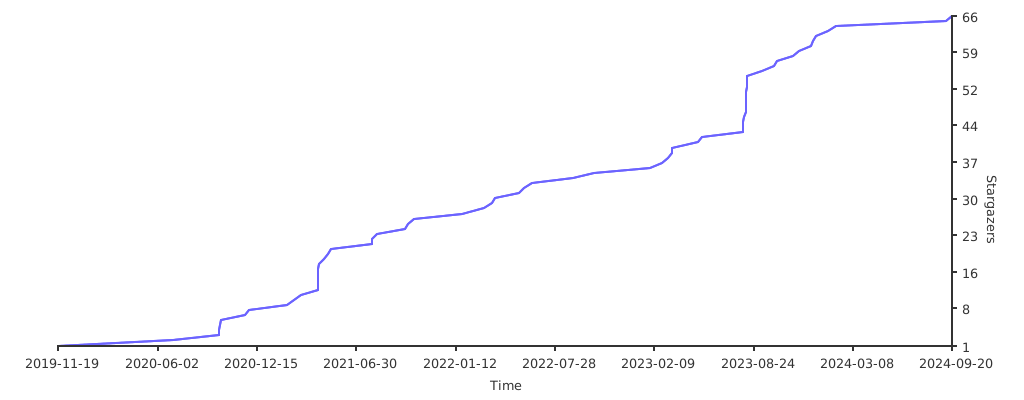
Stargazers over time

Comments
  • Remove upper bound on python_requires

    Remove upper bound on python_requires

    (I'm moving between meetings so can iterate on this more later, so excuse the very brief Issue for now).

    At the moment the project has an upper bound on python_requires

    https://github.com/saforem2/l2hmc-qcd/blob/2eb6ee63cc0c53b187e6d716f4c12f418c8b8515/setup.py#L165

    Assuming that you're intending l2hmc to be a library and not an application, then I would highly recommend removing this for the reasons summarized in Henry's detailed blog post on the subject.

    Congrats on getting l2hmc up on PyPI though! :snake: :rocket:

    opened by matthewfeickert 2
  • Alpha

    Alpha

    Pull upstream alpha branch into main

    Major changes

    • new src/ hierarchical module organization
    • Contains skeleton implementation of 4D SU(3) lattice gauge model
    • Framework independent configuration
      • Unified configuration system simplifies logic, same configs used for both tensorflow and pytorch experiments
      • Plan to be able to specify which backend to use through config option
    • Unified (and framework independent) configurations between tensorflow and pytorch implementations

    Note: This is still very much a WIP. Many existing features still need to be re-implemented / updated into new code in src/.

    Todo

    • [ ] Write unit tests
    • [ ] Use simple configs for end-to-end workflow test + integrate into CI
    • [ ] dynamic learning rate scheduling
    • [ ] Test 4D SU(3) numpy code
    • [ ] Write tensorflow and pytorch implementations of LatticeSU3 objects
    • [ ] Improved / simplified ( / trainable?) annealing schedule
    • [ ] Distributed training support
      • [ ] horovod
      • [ ] DDP for pytorch implementation
      • [ ] DeepSpeed from Microsoft??
    • [ ] Testing / inference logic
    • [ ] Automatic checkpointing
    • [ ] Metric logging
      • [ ] Tensorboard?
      • [ ] Sacred?
      • [ ] build custom dashboard? plot.ly?
    • [ ] Setup packaging / distribution through pip
    • [ ] Resolve issue
    opened by saforem2 1
  • Alpha

    Alpha

    opened by saforem2 1
  • Rich

    Rich

    General improvements, rewrote logging methods to use Rich for better formatting.

    • Adds dynamic (trainable) step size eps for each separate x and v updates, seems to generally increase the total energy towards the middle of the trajectory but it remains unclear if this corresponds to an improvement in the tunneling rate
    • Adds methods for calculating autocorrelations of the topological charge, as well as notebooks for generating the plots
    • Updates to the writeup in doc/main.pdf
    • Will likely be last changes to writeup before public release of official draft
    opened by saforem2 1
  • Dev

    Dev

    • Updates to README

    • Ability to load network with new training instance

    • Updates to doc/, removes old sections related to debugging the bias in the plaquette

    opened by saforem2 1
  • Saveable model

    Saveable model

    Complete rewrite of dynamics.xnet and dynamics.vnet models to use tf.keras.functional Models.

    Additional changes include:

    • Non-Compact Projection update for gauge fields
    • Ability to specify convolution structure to be prepended at beginning of gauge network
    opened by saforem2 1
  • Dev

    Dev

    Removes models/gauge_model.py entirely.

    Instead, a base dynamics class is implemented in dynamics/dynamics.py, and an example subclass is provided in dynamics/gauge_dynamics.py.

    opened by saforem2 1
  • Split networks

    Split networks

    Major rewrite of existing codebase.

    This pull request updates everything to be compatible with tensorflow >= 2.2 and removes a bunch of redundant legacy code.

    opened by saforem2 1
  • Dev

    Dev

    • Dynamics object is now compatible with tf >= 2.0
    • Running inference on trained model with tensorflow now creates identical graphs and summary files to numpy inference code
    • Inference with numpy now uses object oriented structure
    • Adds LaTeX + PDF documentation in doc/
    opened by saforem2 1
  • Cooley dev

    Cooley dev

    Adds new GaugeNetwork architecture as the default for training GaugeModel

    Additionally, replaces pickle with joblib for saving data as .z compressed files (as opposed to .pkl files).

    opened by saforem2 1
  • Testing

    Testing

    Implemented nnehmc_loss calculation for an alternative loss function using the approach suggested in https://infoscience.epfl.ch/record/264887/files/robust_parameter_estimation.pdf.

    This modified loss function can be chosen (instead of the standard loss described in the original paper) by passing --use_nnehmc_loss as a command line argument.

    opened by saforem2 1
  • Packaging and PyPI distribution?

    Packaging and PyPI distribution?

    As you've made a library and are using it as such:

    # snippet from toy_distributions.ipynb
    
    # append parent directory to `sys.path`
    # to load from modules in `../l2hmc-qcd/`
    module_path = os.path.join('..')
    if module_path not in sys.path:
        sys.path.append(module_path)
    
    # Local imports
    from utils.attr_dict import AttrDict
    from utils.training_utils import train_dynamics
    from dynamics.config import DynamicsConfig
    from dynamics.base_dynamics import BaseDynamics
    from dynamics.generic_dynamics import GenericDynamics
    from network.config import LearningRateConfig
    from config import (State, NetWeights, MonteCarloStates,
                        BASE_DIR, BIN_DIR, TF_FLOAT)
    
    from utils.distributions import (plot_samples2D, contour_potential,
                                     two_moons_potential, sin_potential,
                                     sin_potential1, sin_potential2)
    

    do you have any plans and/or interest in packaging it as a Python library so it can either be pip installed from GitHub or be distributed on PyPI?

    opened by matthewfeickert 5
Releases(0.12.0)
Owner
Sam Foreman
Computational science Postdoc at Argonne National Laboratory working on applying machine learning to simulations in lattice QCD.
Sam Foreman
A Large Scale Benchmark for Individual Treatment Effect Prediction and Uplift Modeling

large-scale-ITE-UM-benchmark This repository contains code and data to reproduce the results of the paper "A Large Scale Benchmark for Individual Trea

10 Nov 19, 2022
SmartSim Infrastructure Library.

Home Install Documentation Slack Invite Cray Labs SmartSim SmartSim makes it easier to use common Machine Learning (ML) libraries like PyTorch and Ten

Cray Labs 139 Jan 01, 2023
Cancer metastasis detection with neural conditional random field (NCRF)

NCRF Prerequisites Data Whole slide images Annotations Patch images Model Training Testing Tissue mask Probability map Tumor localization FROC evaluat

Baidu Research 731 Jan 01, 2023
Using machine learning to predict and analyze high and low reader engagement for New York Times articles posted to Facebook.

How The New York Times can increase Engagement on Facebook Using machine learning to understand characteristics of news content that garners "high" Fa

Jessica Miles 0 Sep 16, 2021
AI Face Mesh: This is a simple face mesh detection program based on Artificial intelligence.

AI Face Mesh: This is a simple face mesh detection program based on Artificial Intelligence which made with Python. It's able to detect 468 different

Md. Rakibul Islam 1 Jan 13, 2022
Generative Models as a Data Source for Multiview Representation Learning

GenRep Project Page | Paper Generative Models as a Data Source for Multiview Representation Learning Ali Jahanian, Xavier Puig, Yonglong Tian, Phillip

Ali 81 Dec 03, 2022
Blender Add-on that sets a Material's Base Color to one of Pantone's Colors of the Year

Blender PCOY (Pantone Color of the Year) MCMC (Mid-Century Modern Colors) HG71 (House & Garden Colors 1971) Blender Add-ons That Assign a Custom Color

Don Schnitzius 15 Nov 20, 2022
Implementation of DropLoss for Long-Tail Instance Segmentation in Pytorch

[AAAI 2021]DropLoss for Long-Tail Instance Segmentation [AAAI 2021] DropLoss for Long-Tail Instance Segmentation Ting-I Hsieh*, Esther Robb*, Hwann-Tz

Tim 37 Dec 02, 2022
Combinatorially Hard Games where the levels are procedurally generated

puzzlegen Implementation of two procedurally simulated environments with gym interfaces. IceSlider: the agent needs to reach and stop on the pink squa

Autonomous Learning Group 3 Jun 26, 2022
Python and C++ implementation of "MarkerPose: Robust real-time planar target tracking for accurate stereo pose estimation". Accepted at LXCV @ CVPR 2021.

MarkerPose: Robust real-time planar target tracking for accurate stereo pose estimation This is a PyTorch and LibTorch implementation of MarkerPose: a

Jhacson Meza 47 Nov 18, 2022
Learning-Augmented Dynamic Power Management

Learning-Augmented Dynamic Power Management This repository contains source code accompanying paper Learning-Augmented Dynamic Power Management with M

Adam 0 Feb 22, 2022
Yolov3 pytorch implementation

YOLOV3 Pytorch实现 在bubbliiing大佬代码的基础上进行了修改,添加了部分注释。 预训练模型 预训练模型来源于bubbliiing。 链接:https://pan.baidu.com/s/1ncREw6Na9ycZptdxiVMApw 提取码:appk 训练自己的数据集 按照VO

4 Aug 27, 2022
RL and distillation in CARLA using a factorized world model

World on Rails Learning to drive from a world on rails Dian Chen, Vladlen Koltun, Philipp Krähenbühl, arXiv techical report (arXiv 2105.00636) This re

Dian Chen 131 Dec 16, 2022
Python inverse kinematics for your robot model based on Pinocchio.

Python inverse kinematics for your robot model based on Pinocchio.

Stéphane Caron 50 Dec 22, 2022
Official implementation for (Refine Myself by Teaching Myself : Feature Refinement via Self-Knowledge Distillation, CVPR-2021)

FRSKD Official implementation for Refine Myself by Teaching Myself : Feature Refinement via Self-Knowledge Distillation (CVPR-2021) Requirements Pytho

75 Dec 28, 2022
This is a collection of our NAS and Vision Transformer work.

AutoML - Neural Architecture Search This is a collection of our AutoML-NAS work iRPE (NEW): Rethinking and Improving Relative Position Encoding for Vi

Microsoft 832 Jan 08, 2023
A self-supervised learning framework for audio-visual speech

AV-HuBERT (Audio-Visual Hidden Unit BERT) Learning Audio-Visual Speech Representation by Masked Multimodal Cluster Prediction Robust Self-Supervised A

Meta Research 431 Jan 07, 2023
PyTorch implementation of SmoothGrad: removing noise by adding noise.

SmoothGrad implementation in PyTorch PyTorch implementation of SmoothGrad: removing noise by adding noise. Vanilla Gradients SmoothGrad Guided backpro

SSKH 143 Jan 05, 2023
This is an implementation of Googles Yogi-Optimizer in Keras (tf.keras)

Yogi-Optimizer_Keras This is an implementation of Googles Yogi-Optimizer in Keras (tf.keras) The NeurIPS-Paper can be found here: http://papers.nips.c

14 Sep 13, 2022
The implementation our EMNLP 2021 paper "Enhanced Language Representation with Label Knowledge for Span Extraction".

LEAR The implementation our EMNLP 2021 paper "Enhanced Language Representation with Label Knowledge for Span Extraction". See below for an overview of

杨攀 93 Jan 07, 2023