JupyterLite demo deployed to GitHub Pages 🚀

Related tags

Deep Learningdemo
Overview

JupyterLite Demo

lite-badge

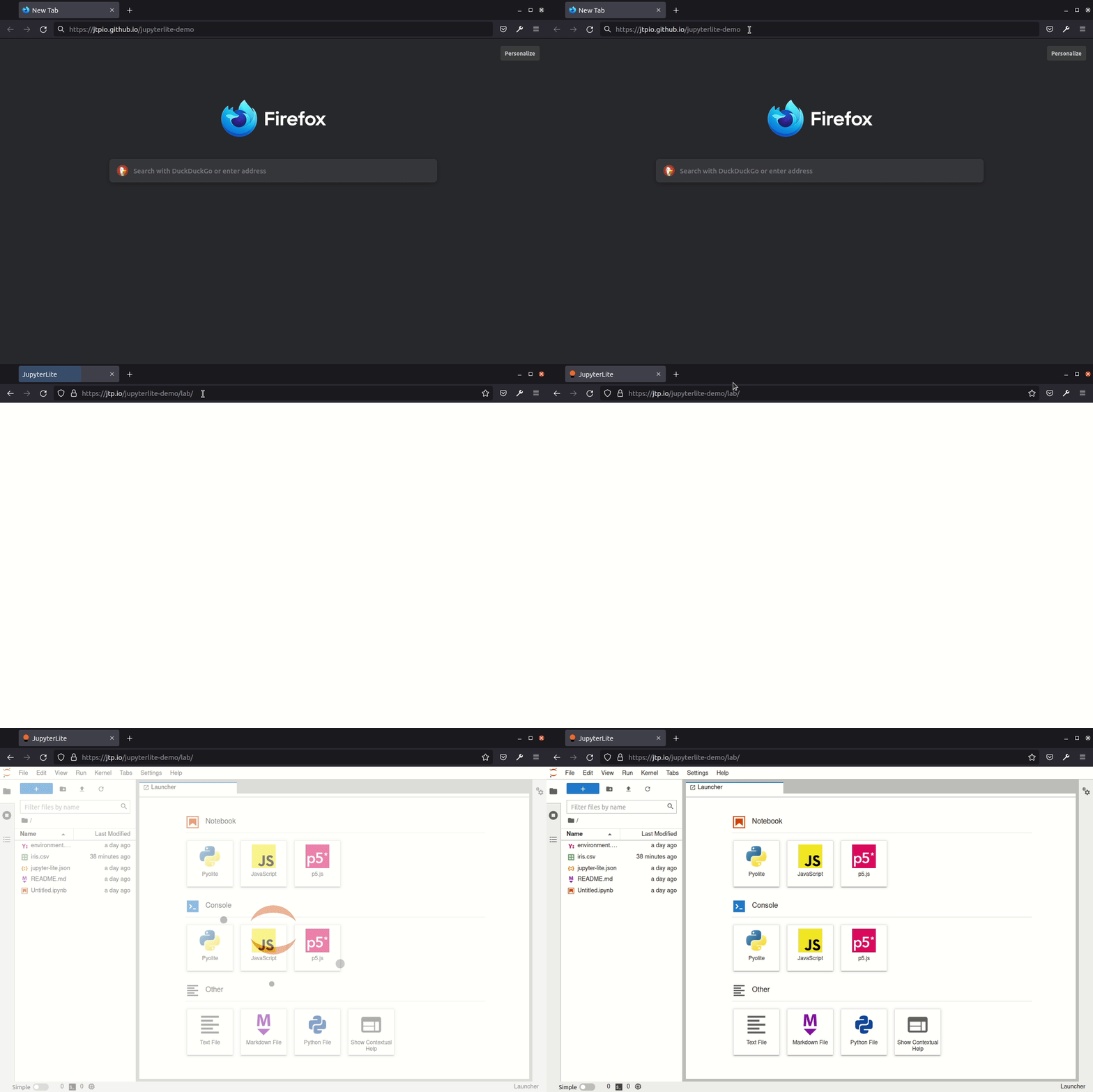
JupyterLite deployed as a static site to GitHub Pages, for demo purposes.

Try it in your browser

➡️ https://jupyterlite.github.io/demo

github-pages

Requirements

JupyterLite is being tested against modern web browsers:

  • Firefox 90+
  • Chromium 89+

Usage

This repository provides a demonstration of how to:

  • build a JupyterLite release using prebuilt JupyterLite assets that bundles a collection of pre-existing Jupyter notebooks as part of the distribution;
  • deploy the release to GitHub Pages.

The process is automated using Github Actions.

You can use this repository in two main ways:

  • generate a new repository from this template repository and build and deploy your own site to the corresponding Github Pages site;
  • build a release from a PR made to this repository and download the release from the created GitHub Actions artifact.

Using Your Own Repository to Build a Release and Deploy it to Github Pages

Requires Github account.

Click on "Use this template" to generate a repository of your own from this template:

template

From the Actions tab on your repository, ensure that workflows are enabled. When you make a commit to the main branch, a Github Action will run to build your JupoyterLite release and deploy it to the repository's Github Pages site. By default, the Github Pages site will be found at YOUR_GITHUB_USERNAME.github.io/YOUR_REPOSITORY-NAME. You can also check the URL from the Repository Settings tab Pages menu item.

If the deployment failed, go to "Settings - Actions - General", in the "Workflow permissions" section, check "Read and write permissions". Update files such as readme, and commit so that GitHub rebuids and re-deploys the project. Go to "Settings - Pages", choose "gh-pages" as the source.

Add any additional requirements as required to the requirements.txt file.

You can do this via the Github website by selecting the requirements.txt file, clicking to edit it, making the required changes then saving ("committing") the result to the main branch of your repository.

Modify the contents of the contents folder to include the notebooks you want to distribute as part of your distribution.

You can do this by clicking on the contents directory and dragging notebooks from your desktop onto the contents listing. Wait for the files to be uploaded and then save them ("commit" them) to the main branch of the repository.

Check that you have Github Pages enabled for your repository: from your repository Settings tab, select the Pages menu item and ensure that the source is set to gh-pages.

When you commit a file, an updated release will be built and published on the Github Pages site. Note that it may take a few minutes for the Github Pages site to be updated. Do a hard refresh on your Github Pages site in your web browser to see the new release.

Further Information and Updates

For more info, keep an eye on the JupyterLite documentation:

Deploy a new version of JupyterLite

To change the version of the prebuilt JupyterLite assets, update the jupyterlite package version in the requirements.txt file.

The requirements.txt file can also be used to add extra prebuilt ("federated") JupyterLab extensions to the deployed JupyterLite website.

Commit and push any changes. The site will be deployed on the next push to the main branch.

Development

Create a new environment:

mamba create -n jupyterlite-demo
conda activate jupyterlite-demo
pip install -r requirements.txt

Then follow the steps documented in the Configuring section.

Owner
JupyterLite
Wasm powered Jupyter running in the browser 💡
JupyterLite
A Semantic Segmentation Network for Urban-Scale Building Footprint Extraction Using RGB Satellite Imagery

A Semantic Segmentation Network for Urban-Scale Building Footprint Extraction Using RGB Satellite Imagery This repository is the official implementati

Aatif Jiwani 42 Dec 08, 2022
MBPO (paper: When to trust your model: Model-based policy optimization) in offline RL settings

offline-MBPO This repository contains the code of a version of model-based RL algorithm MBPO, which is modified to perform in offline RL settings Pape

LxzGordon 1 Oct 24, 2021
Implements Stacked-RNN in numpy and torch with manual forward and backward functions

Recurrent Neural Networks Implements simple recurrent network and a stacked recurrent network in numpy and torch respectively. Both flavours implement

Vishal R 1 Nov 16, 2021
Official implementation of AAAI-21 paper "Label Confusion Learning to Enhance Text Classification Models"

Description: This is the official implementation of our AAAI-21 accepted paper Label Confusion Learning to Enhance Text Classification Models. The str

101 Nov 25, 2022
Implement of "Training deep neural networks via direct loss minimization" in PyTorch for 0-1 loss

This is the implementation of "Training deep neural networks via direct loss minimization" published at ICML 2016 in PyTorch. The implementation targe

Cuong Nguyen 1 Jan 18, 2022
OpenMMLab 3D Human Parametric Model Toolbox and Benchmark

Introduction English | 简体中文 MMHuman3D is an open source PyTorch-based codebase for the use of 3D human parametric models in computer vision and comput

OpenMMLab 782 Jan 04, 2023
Semantic Scholar's Author Disambiguation Algorithm & Evaluation Suite

S2AND This repository provides access to the S2AND dataset and S2AND reference model described in the paper S2AND: A Benchmark and Evaluation System f

AI2 54 Nov 28, 2022
《Lerning n Intrinsic Grment Spce for Interctive Authoring of Grment Animtion》

Learning an Intrinsic Garment Space for Interactive Authoring of Garment Animation Overview This is the demo code for training a motion invariant enco

YuanBo 213 Dec 14, 2022
simple demo codes for Learning to Teach with Dynamic Loss Functions

Learning to Teach with Dynamic Loss Functions This repo contains the simple demo for the NeurIPS-18 paper: Learning to Teach with Dynamic Loss Functio

Lijun Wu 15 Dec 30, 2021
Implementation of SwinTransformerV2 in TensorFlow.

SwinTransformerV2-TensorFlow A TensorFlow implementation of SwinTransformerV2 by Microsoft Research Asia, based on their official implementation of Sw

Phan Nguyen 2 May 30, 2022
Code repository for paper `Skeleton Merger: an Unsupervised Aligned Keypoint Detector`.

Skeleton Merger Skeleton Merger, an Unsupervised Aligned Keypoint Detector. The paper is available at https://arxiv.org/abs/2103.10814. A map of the r

北海若 48 Nov 14, 2022
Multi-Anchor Active Domain Adaptation for Semantic Segmentation (ICCV 2021 Oral)

Multi-Anchor Active Domain Adaptation for Semantic Segmentation Munan Ning*, Donghuan Lu*, Dong Wei†, Cheng Bian, Chenglang Yuan, Shuang Yu, Kai Ma, Y

Munan Ning 36 Dec 07, 2022
MetaTTE: a Meta-Learning Based Travel Time Estimation Model for Multi-city Scenarios

MetaTTE: a Meta-Learning Based Travel Time Estimation Model for Multi-city Scenarios This is the official TensorFlow implementation of MetaTTE in the

morningstarwang 4 Dec 14, 2022
A Demo server serving Bert through ONNX with GPU written in Rust with <3

Demo BERT ONNX server written in rust This demo showcase the use of onnxruntime-rs on BERT with a GPU on CUDA 11 served by actix-web and tokenized wit

Xavier Tao 28 Jan 01, 2023
Fast sparse deep learning on CPUs

SPARSEDNN **If you want to use this repo, please send me an email: [email pro

Ziheng Wang 44 Nov 30, 2022
Unet network with mean teacher for altrasound image segmentation

Unet network with mean teacher for altrasound image segmentation

5 Nov 21, 2022
The pyrelational package offers a flexible workflow to enable active learning with as little change to the models and datasets as possible

pyrelational is a python active learning library developed by Relation Therapeutics for rapidly implementing active learning pipelines from data management, model development (and Bayesian approximat

Relation Therapeutics 95 Dec 27, 2022
TensorFlow implementation for Bayesian Modeling and Uncertainty Quantification for Learning to Optimize: What, Why, and How

Bayesian Modeling and Uncertainty Quantification for Learning to Optimize: What, Why, and How TensorFlow implementation for Bayesian Modeling and Unce

Shen Lab at Texas A&M University 8 Sep 02, 2022
This repository contains an overview of important follow-up works based on the original Vision Transformer (ViT) by Google.

This repository contains an overview of important follow-up works based on the original Vision Transformer (ViT) by Google.

75 Dec 02, 2022
PyTorch implementation for paper Neural Marching Cubes.

NMC PyTorch implementation for paper Neural Marching Cubes, Zhiqin Chen, Hao Zhang. Paper | Supplementary Material (to be updated) Citation If you fin

Zhiqin Chen 109 Dec 27, 2022