Boosting Monocular Depth Estimation Models to High-Resolution via Content-Adaptive Multi-Resolution Merging

Overview

Boosting Monocular Depth Estimation Models to High-Resolution via Content-Adaptive Multi-Resolution Merging

This repository contains an implementation of our CVPR2021 publication:

Boosting Monocular Depth Estimation Models to High-Resolution via Content-Adaptive Multi-Resolution Merging. S. Mahdi H. Miangoleh, Sebastian Dille, Long Mai, Sylvain Paris, Yağız Aksoy. Main pdf, Supplementary pdf, Project Page.
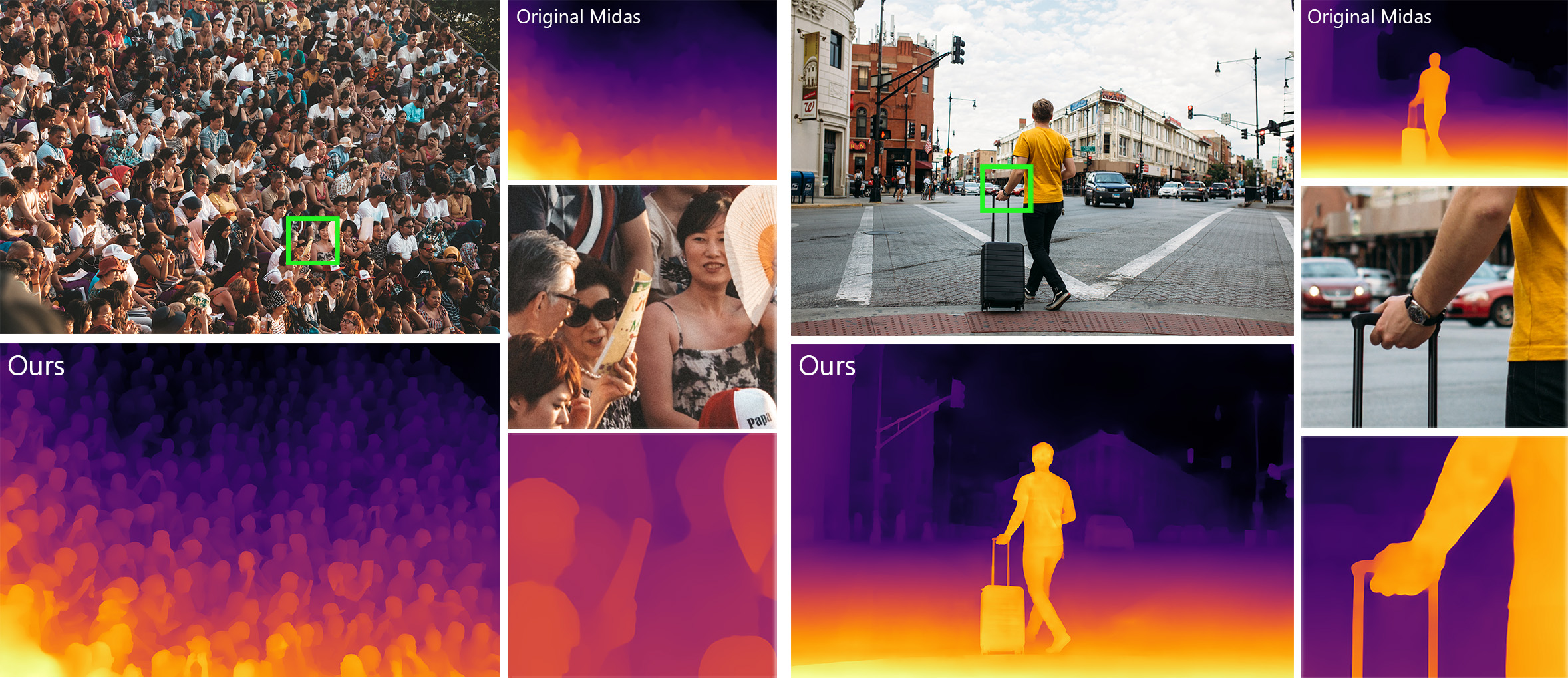
Teaserimage

Change log:

Setup

We Provided the implementation of our method using MiDas-v2 and SGRnet as the base.

Environments

Our mergenet model is trained using torch 0.4.1 and python 3.6 and is tested with torch<=1.8.

Download our mergenet model weights from here and put it in

.\pix2pix\checkpoints\mergemodel\latest_net_G.pth

To use MiDas-v2 as base: Install dependancies as following:

conda install pytorch torchvision opencv cudatoolkit=10.2 -c pytorch
conda install matplotlib
conda install scipy
conda install scikit-image

Download the model weights from MiDas-v2 and put it in

./midas/model.pt

activate the environment
python run.py --Final --data_dir PATH_TO_INPUT --output_dir PATH_TO_RESULT --depthNet 0

To use SGRnet as base: Install dependancies as following:

conda install pytorch=0.4.1 cuda92 -c pytorch
conda install torchvision
conda install matplotlib
conda install scikit-image
pip install opencv-python

Follow the official SGRnet repository to compile the syncbn module in ./structuredrl/models/syncbn. Download the model weights from SGRnet and put it in

./structuredrl/model.pth.tar

activate the environment
python run.py --Final --data_dir PATH_TO_INPUT --output_dir PATH_TO_RESULT --depthNet 1

Different input arguments can be used to generate R0 and R20 results as discussed in the paper.

python run.py --R0 --data_dir PATH_TO_INPUT --output_dir PATH_TO_RESULT --depthNet #[0or1]
python run.py --R20 --data_dir PATH_TO_INPUT --output_dir PATH_TO_RESULT --depthNet #[0or1]

Evaluation

Fill in the needed variables in the following matlab file and run:

./evaluation/evaluatedataset.m

  • estimation_path : path to estimated disparity maps
  • gt_depth_path : path to gt depth/disparity maps
  • dataset_disp_gttype : (true) if ground truth data is disparity and (false) if gt depth data is depth.
  • evaluation_matfile_save_dir : directory to save the evalution results as .mat file.
  • superpixel_scale : scale parameter to run the superpixels on scaled version of the ground truth images to accelarate the evaluation. use 1 for small gt images.

Training

Navigate to dataset preparation instructions to download and prepare the training dataset.

python ./pix2pix/train.py --dataroot DATASETDIR --name mergemodeltrain --model pix2pix4depth --no_flip --no_dropout
python ./pix2pix/test.py --dataroot DATASETDIR --name mergemodeleval --model pix2pix4depth --no_flip --no_dropout

Citation

This implementation is provided for academic use only. Please cite our paper if you use this code or any of the models.

@INPROCEEDINGS{Miangoleh2021Boosting,
author={S. Mahdi H. Miangoleh and Sebastian Dille and Long Mai and Sylvain Paris and Ya\u{g}{\i}z Aksoy},
title={Boosting Monocular Depth Estimation Models to High-Resolution via Content-Adaptive Multi-Resolution Merging},
journal={Proc. CVPR},
year={2021},
}

Credits

The "Merge model" code skeleton (./pix2pix folder) was adapted from the pytorch-CycleGAN-and-pix2pix repository.

For MiDaS and SGR inferences we used the scripts and models from MiDas-v2 and SGRnet respectively (./midas and ./structuredrl folders).

Thanks to k-washi for providing us with a Google Colaboratory notebook implementation.

Owner
Computational Photography Lab @ SFU
Computational Photography Lab at Simon Fraser University, lead by @yaksoy
Computational Photography Lab @ SFU
This package contains deep learning models and related scripts for RoseTTAFold

RoseTTAFold This package contains deep learning models and related scripts to run RoseTTAFold This repository is the official implementation of RoseTT

1.6k Jan 03, 2023
Official Code Implementation of the paper : XAI for Transformers: Better Explanations through Conservative Propagation

Official Code Implementation of The Paper : XAI for Transformers: Better Explanations through Conservative Propagation For the SST-2 and IMDB expermin

Ameen Ali 23 Dec 30, 2022
StyleTransfer - Open source style transfer project, based on VGG19

StyleTransfer - Open source style transfer project, based on VGG19

Patrick martins de lima 9 Dec 13, 2021
ReSSL: Relational Self-Supervised Learning with Weak Augmentation

ReSSL: Relational Self-Supervised Learning with Weak Augmentation This repository contains PyTorch evaluation code, training code and pretrained model

mingkai 45 Oct 25, 2022
Julia and Matlab codes to simulated all problems in El-Hachem, McCue and Simpson (2021)

Substrate_Mediated_Invasion Julia and Matlab codes to simulated all problems in El-Hachem, McCue and Simpson (2021) 2DSolver.jl reproduces the simulat

Matthew Simpson 0 Nov 09, 2021
This is an open solution to the Home Credit Default Risk challenge 🏡

Home Credit Default Risk: Open Solution This is an open solution to the Home Credit Default Risk challenge 🏡 . More competitions 🎇 Check collection

minerva.ml 427 Dec 27, 2022
This is a Deep Leaning API for classifying emotions from human face and human audios.

Emotion AI This is a Deep Leaning API for classifying emotions from human face and human audios. Starting the server To start the server first you nee

crispengari 5 Oct 02, 2022
Code release for our paper, "SimNet: Enabling Robust Unknown Object Manipulation from Pure Synthetic Data via Stereo"

SimNet: Enabling Robust Unknown Object Manipulation from Pure Synthetic Data via Stereo Thomas Kollar, Michael Laskey, Kevin Stone, Brijen Thananjeyan

68 Dec 14, 2022
Code for ICCV 2021 paper "HuMoR: 3D Human Motion Model for Robust Pose Estimation"

Code for ICCV 2021 paper "HuMoR: 3D Human Motion Model for Robust Pose Estimation"

Davis Rempe 367 Dec 24, 2022
Accuracy Aligned. Concise Implementation of Swin Transformer

Accuracy Aligned. Concise Implementation of Swin Transformer This repository contains the implementation of Swin Transformer, and the training codes o

FengWang 77 Dec 16, 2022
JumpDiff: Non-parametric estimator for Jump-diffusion processes for Python

jumpdiff jumpdiff is a python library with non-parametric Nadaraya─Watson estimators to extract the parameters of jump-diffusion processes. With jumpd

Rydin 28 Dec 10, 2022
FcaNet: Frequency Channel Attention Networks

FcaNet: Frequency Channel Attention Networks PyTorch implementation of the paper "FcaNet: Frequency Channel Attention Networks". Simplest usage Models

327 Dec 27, 2022
SGoLAM - Simultaneous Goal Localization and Mapping

SGoLAM - Simultaneous Goal Localization and Mapping PyTorch implementation of the MultiON runner-up entry, SGoLAM: Simultaneous Goal Localization and

10 Jan 05, 2023
MediaPipeのPythonパッケージのサンプルです。2020/12/11時点でPython実装のある4機能(Hands、Pose、Face Mesh、Holistic)について用意しています。

mediapipe-python-sample MediaPipeのPythonパッケージのサンプルです。 2020/12/11時点でPython実装のある以下4機能について用意しています。 Hands Pose Face Mesh Holistic Requirement mediapipe 0.

KazuhitoTakahashi 217 Dec 12, 2022
TOOD: Task-aligned One-stage Object Detection, ICCV2021 Oral

One-stage object detection is commonly implemented by optimizing two sub-tasks: object classification and localization, using heads with two parallel branches, which might lead to a certain level of

264 Jan 09, 2023
BLEURT is a metric for Natural Language Generation based on transfer learning.

BLEURT: a Transfer Learning-Based Metric for Natural Language Generation BLEURT is an evaluation metric for Natural Language Generation. It takes a pa

Google Research 492 Jan 05, 2023
Unbiased Learning To Rank Algorithms (ULTRA)

This is an Unbiased Learning To Rank Algorithms (ULTRA) toolbox, which provides a codebase for experiments and research on learning to rank with human annotated or noisy labels.

71 Dec 01, 2022
Deep Learning Interviews book: Hundreds of fully solved job interview questions from a wide range of key topics in AI.

This book was written for you: an aspiring data scientist with a quantitative background, facing down the gauntlet of the interview process in an increasingly competitive field. For most of you, the

4.1k Dec 28, 2022
Learning Lightweight Low-Light Enhancement Network using Pseudo Well-Exposed Images

Learning Lightweight Low-Light Enhancement Network using Pseudo Well-Exposed Images This repository contains the implementation of the following paper

Seonggwan Ko 9 Jul 30, 2022
Official PyTorch implementation of the Fishr regularization for out-of-distribution generalization

Fishr: Invariant Gradient Variances for Out-of-distribution Generalization Official PyTorch implementation of the Fishr regularization for out-of-dist

62 Dec 22, 2022