A python library to build Model Trees with Linear Models at the leaves.

Overview

linear-tree

A python library to build Model Trees with Linear Models at the leaves.

Overview

Linear Model Trees combine the learning ability of Decision Tree with the predictive and explicative power of Linear Models. Like in tree-based algorithms, the data are split according to simple decision rules. The goodness of slits is evaluated in gain terms fitting Linear Models in the nodes. This implies that the models in the leaves are linear instead of constant approximations like in classical Decision Trees.

linear-tree is developed to be fully integrable with scikit-learn. LinearTreeRegressor and LinearTreeClassifier are provided as scikit-learn BaseEstimator. They are wrappers that build a decision tree on the data fitting a linear estimator from sklearn.linear_model. All the models available in sklearn.linear_model can be used as linear estimators.

Installation

pip install linear-tree

The module depends on NumPy, SciPy and Scikit-Learn (>=0.23.0). Python 3.6 or above is supported.

Media

Usage

Regression
from sklearn.linear_model import LinearRegression
from lineartree import LinearTreeRegressor
from sklearn.datasets import make_regression
X, y = make_regression(n_samples=100, n_features=4,
                       n_informative=2, n_targets=1,
                       random_state=0, shuffle=False)
regr = LinearTreeRegressor(base_estimator=LinearRegression())
regr.fit(X, y)
Classification
from sklearn.linear_model import RidgeClassifier
from lineartree import LinearTreeClassifier
from sklearn.datasets import make_classification
X, y = make_classification(n_samples=100, n_features=4,
                           n_informative=2, n_redundant=0,
                           random_state=0, shuffle=False)
clf = LinearTreeClassifier(base_estimator=RidgeClassifier())
clf.fit(X, y)

More examples in the notebooks folder.

Check the API Reference to see the parameter configurations and the available methods.

Examples

Show the model tree structure:
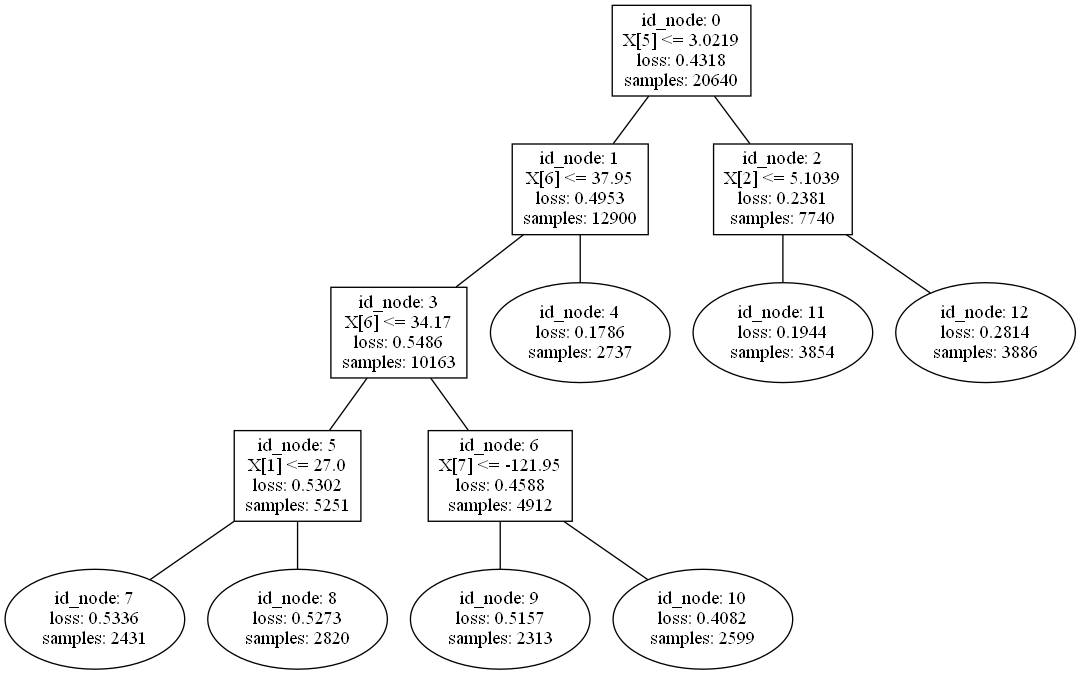
plot tree

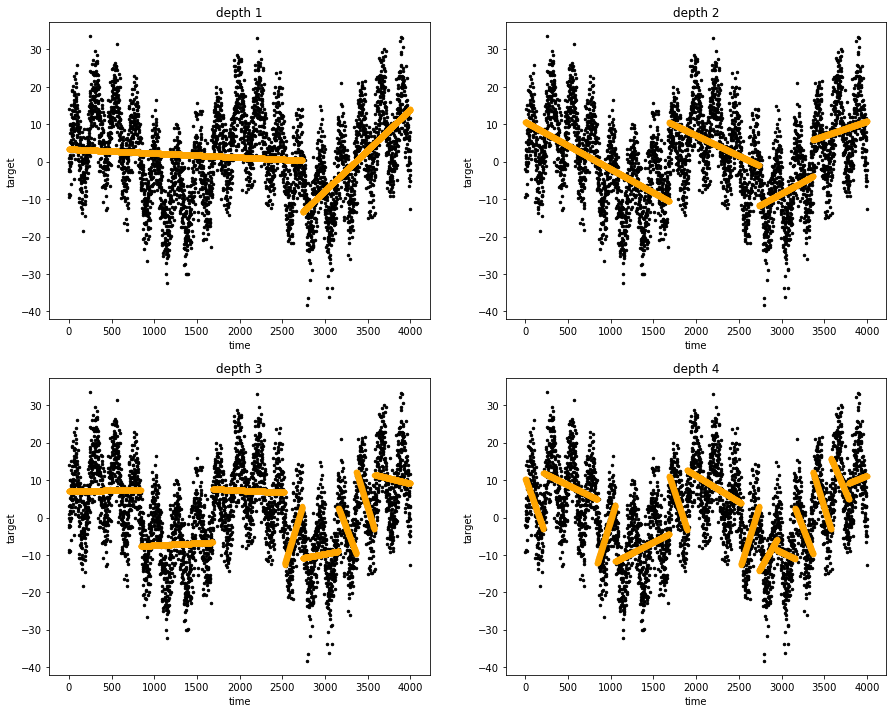
Linear Tree Regressor at work:

linear tree regressor

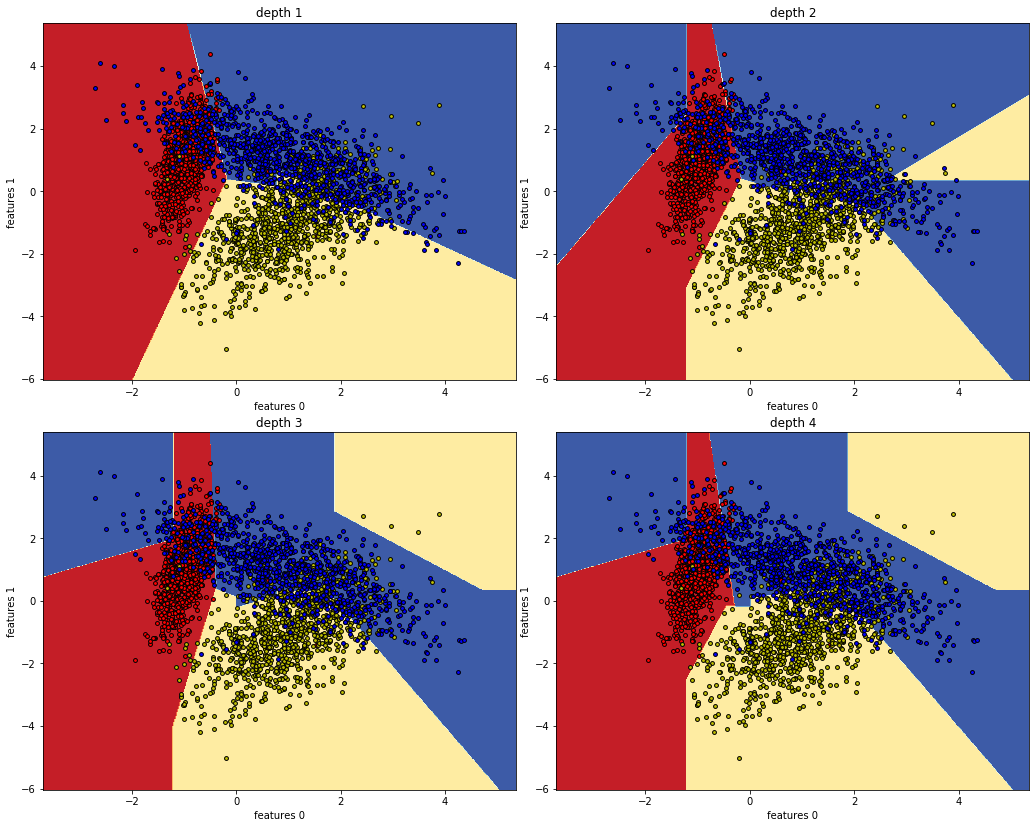
Linear Tree Classifier at work:

linear tree classifier

Extract and examine coefficients at the leaves:
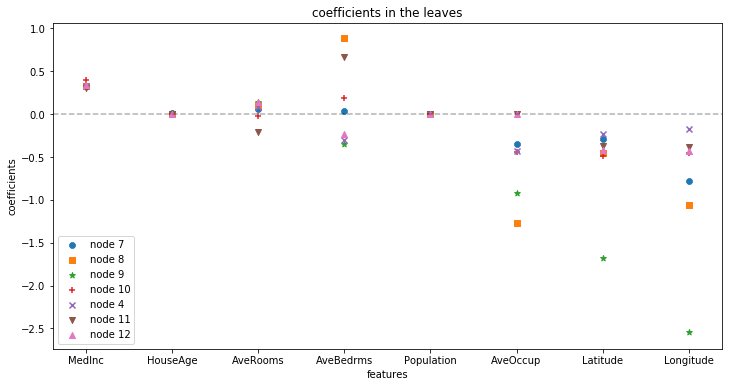
leaf coefficients

Comments
  • finding breakpoint

    finding breakpoint

    Hello,

    thank you for your nice tool. I am using the function LinearTreeRegressor to draw a continuous piecewise linear. It works well, I am wondering, is it possible to show the location (the coordinates) of the breakpoints?

    thank you

    opened by ZhengLiu1119 5
  • Allow the hyperparameter

    Allow the hyperparameter "max_depth = 0".

    Thanks for the good library.

    When using LinearTreeRegressor, I think that max_depth is often optimized by cross-validation.

    This library allows max_depth in the range 1-20. However, depending on the dataset, simple linear regression may be suitable. Even in such a dataset, max_depth is forced to be 1 or more, so Simple Linear Regression cannot be applied properly with LinearTreeRegressor.

    • Of course, it is appropriate to use sklearn.linear_model.LinearRegression for such datasets.

    My suggestion is to change to a program that uses base_estimator to perform regression when "max_depth = 0". With this change, LinearTreeRegressor can flexibly respond to both segmented regression and simple regression by changing hyperparameters.

    opened by jckkvs 4
  • Error when running with multiple jobs: unexpected keyword argument 'target_offload'

    Error when running with multiple jobs: unexpected keyword argument 'target_offload'

    I have been using your library for quite a while and am super happy with it. So first, thanks a lot!

    Lately, I used my framework (which also uses your library) on modern many core server with many jobs. Worked fine. Now I have updated everything via pip and with 8 jobs on my MacBook, I got the following error.

    This error does not occur when using only a single job (I pass the number of jobs to n_jobs).

    I cannot nail the down the actual problem, but since it occurred right after the upgrade, I assume this might be the reason?

    Am I doing something wrong here?

    """
    Traceback (most recent call last):
      File "/Users/martin/opt/anaconda3/lib/python3.7/site-packages/joblib/externals/loky/process_executor.py", line 436, in _process_worker
        r = call_item()
      File "/Users/martin/opt/anaconda3/lib/python3.7/site-packages/joblib/externals/loky/process_executor.py", line 288, in __call__
        return self.fn(*self.args, **self.kwargs)
      File "/Users/martin/opt/anaconda3/lib/python3.7/site-packages/joblib/_parallel_backends.py", line 595, in __call__
        return self.func(*args, **kwargs)
      File "/Users/martin/opt/anaconda3/lib/python3.7/site-packages/joblib/parallel.py", line 263, in __call__
        for func, args, kwargs in self.items]
      File "/Users/martin/opt/anaconda3/lib/python3.7/site-packages/joblib/parallel.py", line 263, in <listcomp>
        for func, args, kwargs in self.items]
      File "/Users/martin/opt/anaconda3/lib/python3.7/site-packages/lineartree/_classes.py", line 56, in __call__
        with config_context(**self.config):
      File "/Users/martin/opt/anaconda3/lib/python3.7/contextlib.py", line 239, in helper
        return _GeneratorContextManager(func, args, kwds)
      File "/Users/martin/opt/anaconda3/lib/python3.7/contextlib.py", line 82, in __init__
        self.gen = func(*args, **kwds)
    TypeError: config_context() got an unexpected keyword argument 'target_offload'
    """
    
    The above exception was the direct cause of the following exception:
    
    Traceback (most recent call last):
      File "compression_selection_pipeline.py", line 41, in <module>
        model_pipeline.learn_runtime_models(calibration_result_dir)
      File "/Users/martin/Programming/compression_selection_v3/hyrise_calibration/model_pipeline.py", line 670, in learn_runtime_models
        non_splitting_models("table_scan", table_scans)
      File "/Users/martin/Programming/compression_selection_v3/hyrise_calibration/model_pipeline.py", line 590, in non_splitting_models
        fitted_model = model_dict["model"].fit(X_train, y_train)
      File "/Users/martin/Programming/compression_selection_v3/hyrise_calibration/model_pipeline.py", line 209, in fit
        return self.regression.fit(X, y)
      File "/Users/martin/opt/anaconda3/lib/python3.7/site-packages/lineartree/lineartree.py", line 187, in fit
        self._fit(X, y, sample_weight)
      File "/Users/martin/opt/anaconda3/lib/python3.7/site-packages/lineartree/_classes.py", line 576, in _fit
        self._grow(X, y, sample_weight)
      File "/Users/martin/opt/anaconda3/lib/python3.7/site-packages/lineartree/_classes.py", line 387, in _grow
        loss=loss)
      File "/Users/martin/opt/anaconda3/lib/python3.7/site-packages/lineartree/_classes.py", line 285, in _split
        for feat in split_feat)
      File "/Users/martin/opt/anaconda3/lib/python3.7/site-packages/joblib/parallel.py", line 1056, in __call__
        self.retrieve()
      File "/Users/martin/opt/anaconda3/lib/python3.7/site-packages/joblib/parallel.py", line 935, in retrieve
        self._output.extend(job.get(timeout=self.timeout))
      File "/Users/martin/opt/anaconda3/lib/python3.7/site-packages/joblib/_parallel_backends.py", line 542, in wrap_future_result
        return future.result(timeout=timeout)
      File "/Users/martin/opt/anaconda3/lib/python3.7/concurrent/futures/_base.py", line 435, in result
        return self.__get_result()
      File "/Users/martin/opt/anaconda3/lib/python3.7/concurrent/futures/_base.py", line 384, in __get_result
        raise self._exception
    TypeError: config_context() got an unexpected keyword argument 'target_offload'
    

    PS: I have already left a star. :D

    opened by Bouncner 3
  • Option to specify features to use for splitting and for leaf models

    Option to specify features to use for splitting and for leaf models

    Added two additional parameters:

    • split_features: Indices of features that can be used for splitting. Default all.
    • linear_features: Indices of features that are used by the linear models in the leaves. Default all except for categorical features

    This implements a feature requested in https://github.com/cerlymarco/linear-tree/issues/2

    Potential performance improvement: Currently the code still computes bins for all features and not only for those used for splitting.

    opened by JonasRauch 3
  • Rationale for rounding during _parallel_binning_fit and _grow

    Rationale for rounding during _parallel_binning_fit and _grow

    I noticed that the implementations of _parallel_binning_fit and _grow internally round loss values to 5 decimal places. This makes the regression results dependent on the scale of the labels, as data with a lower natural loss value will result in many different splits of the data having the same loss when rounded to 5 decimal places. Is there a reason why this is the case?

    This behavior can be observed by fitting a LinearTreeRegressor using the default loss function and multiplying the scale of the labels by a small number (like 1e-9). This will result in the regressor no longer learning any splits.

    opened by session-id 2
  • ValueError: Invalid parameter linearforestregression for estimator Pipeline

    ValueError: Invalid parameter linearforestregression for estimator Pipeline

    Great work! I'm new to ML and stuck with this. I'm trying to combine pipeline and GridSearch to search for best possible hyperparameters for a model.

    image

    I got the following error:

    image

    Kindly help : )

    opened by NousMei 2
  • Performance and possibility to split only on subset of features

    Performance and possibility to split only on subset of features

    Hey, I have been playing around a lot with your linear trees. Like them very much. Thanks!

    Nevertheless, I am somewhat disappointed by the runtime performance. Compared to XGBoost Regressors (I know it's not a fair comparison) or linear regressions (also not fair), the linear tree is reeeeeaally slow. 50k observations, 80 features: 2s for linear regression, 27s for XGBoost, and 300s for the linear tree. Have you seen similar runtimes or might I be using it wrong?

    Another aspects that's interesting to me is the question whether is possibe to limit the features which are used for splits. I haven't found it in the code. Any change to see it in the future?

    opened by Bouncner 2
  • export to graphviz  -AttributeError: 'LinearTreeRegressor' object has no attribute 'n_features_'

    export to graphviz -AttributeError: 'LinearTreeRegressor' object has no attribute 'n_features_'

    Hi

    thanks for writing this great package!

    I was trying to display the decision tree with graphviz I get this error

    AttributeError: 'LinearTreeRegressor' object has no attribute 'n_features_'

    from lineartree import LinearTreeRegressor from sklearn.linear_model import LinearRegression

    reg = LinearTreeRegressor(base_estimator=LinearRegression()) reg.fit(train[x_cols], train["y"])

    from graphviz import Source from sklearn import tree

    graph = Source( tree.export_graphviz(reg, out_file=None,feature_names=train.columns))

    opened by ricmarchao 2
  • numpy deprecation warning

    numpy deprecation warning

    /lineartree/_classes.py:338: DeprecationWarning:

    the interpolation= argument to quantile was renamed to method=, which has additional options. Users of the modes 'nearest', 'lower', 'higher', or 'midpoint' are encouraged to review the method they. (Deprecated NumPy 1.22)

    Seems like a quick update here would get this warning to stop showing up, right? I can always ignore it, but figured I would mention it in case it is actually an error on my side.

    Also, sorry, I don't actually what the best open source etiquette is. If I'm supposed to create a pull request with a proposed fix instead of just mentioning it then feel free to correct me.

    opened by paul-brenner 1
  • How to gridsearch tree and regression parameters?

    How to gridsearch tree and regression parameters?

    Hi, I am wondering how to perform a GridsearchCV to find best parameters for the tree and regression model? For now I am able to tune the tree component of my model:

    `

     param_grid={
        'n_estimators': [50, 100, 500, 700],
        'max_depth': [10, 20, 30, 50],
        'min_samples_split' : [2, 4, 8, 16, 32],
        'max_features' : ['sqrt', 'log2', None]
    }
    cv = RepeatedKFold(n_repeats=3,
                       n_splits=3,
                       random_state=1)
    
    model = GridSearchCV(
        LinearForestRegressor(ElasticNet(random_state = 0), random_state=42),
        param_grid=param_grid,
        n_jobs=-1,
        cv=cv,
        scoring='neg_root_mean_squared_error'
        )
    

    `

    opened by zuzannakarwowska 1
  • Potential bug in LinearForestClassifier 'predict_proba'

    Potential bug in LinearForestClassifier 'predict_proba'

    Hello! Thank you for useful package!

    I think I might have found a potential bug in LinearForestClassifier.

    I expected 'predict_proba' to use 'self.decision_function', similarly to 'predict' - to include predictions from both estimators (base + forest). Is that a potential bug or am I in wrong here?

    https://github.com/cerlymarco/linear-tree/blob/8d5beca8d492cb8c57e6618e3fb770860f28b550/lineartree/lineartree.py#L1560

    opened by PiotrKaszuba 1
Releases(0.3.5)
Owner
Marco Cerliani
Statistician Hacker & Data Scientist
Marco Cerliani
YOLTv5 rapidly detects objects in arbitrarily large aerial or satellite images that far exceed the ~600×600 pixel size typically ingested by deep learning object detection frameworks

YOLTv5 rapidly detects objects in arbitrarily large aerial or satellite images that far exceed the ~600×600 pixel size typically ingested by deep learning object detection frameworks.

Adam Van Etten 145 Jan 01, 2023
PartImageNet is a large, high-quality dataset with part segmentation annotations

PartImageNet: A Large, High-Quality Dataset of Parts We will release our dataset and scripts soon after cleaning and approval. Introduction PartImageN

Ju He 77 Nov 30, 2022
Code repo for "Transformer on a Diet" paper

Transformer on a Diet Reference: C Wang, Z Ye, A Zhang, Z Zhang, A Smola. "Transformer on a Diet". arXiv preprint arXiv (2020). Installation pip insta

cgraywang 31 Sep 26, 2021
This repository contains FEDOT - an open-source framework for automated modeling and machine learning (AutoML)

package tests docs license stats support This repository contains FEDOT - an open-source framework for automated modeling and machine learning (AutoML

National Center for Cognitive Research of ITMO University 482 Dec 26, 2022
Self-Supervised Image Denoising via Iterative Data Refinement

Self-Supervised Image Denoising via Iterative Data Refinement Yi Zhang1, Dasong Li1, Ka Lung Law2, Xiaogang Wang1, Hongwei Qin2, Hongsheng Li1 1CUHK-S

Zhang Yi 72 Jan 01, 2023
The second project in Python course on FCC

Assignment Write a function named add_time that takes in two required parameters and one optional parameter: a start time in the 12-hour clock format

Denise T 1 Dec 13, 2021
Official implementation of "Dynamic Anchor Learning for Arbitrary-Oriented Object Detection" (AAAI2021).

DAL This project hosts the official implementation for our AAAI 2021 paper: Dynamic Anchor Learning for Arbitrary-Oriented Object Detection [arxiv] [c

ming71 215 Nov 28, 2022
Deep Learning Algorithms for Hedging with Frictions

Deep Learning Algorithms for Hedging with Frictions This repository contains the Forward-Backward Stochastic Differential Equation (FBSDE) solver and

Xiaofei Shi 3 Dec 22, 2022
The repository contains source code and models to use PixelNet architecture used for various pixel-level tasks. More details can be accessed at .

PixelNet: Representation of the pixels, by the pixels, and for the pixels. We explore design principles for general pixel-level prediction problems, f

Aayush Bansal 196 Aug 10, 2022
Code for the ICASSP-2021 paper: Continuous Speech Separation with Conformer.

Continuous Speech Separation with Conformer Introduction We examine the use of the Conformer architecture for continuous speech separation. Conformer

Sanyuan Chen (陈三元) 81 Nov 28, 2022
wlad 2 Dec 19, 2022
Framework for training options with different attention mechanism and using them to solve downstream tasks.

Using Attention in HRL Framework for training options with different attention mechanism and using them to solve downstream tasks. Requirements GPU re

5 Nov 03, 2022
Automates Machine Learning Pipeline with Feature Engineering and Hyper-Parameters Tuning :rocket:

MLJAR Automated Machine Learning Documentation: https://supervised.mljar.com/ Source Code: https://github.com/mljar/mljar-supervised Table of Contents

MLJAR 2.4k Dec 31, 2022
Distributed Asynchronous Hyperparameter Optimization in Python

Hyperopt: Distributed Hyperparameter Optimization Hyperopt is a Python library for serial and parallel optimization over awkward search spaces, which

6.5k Jan 01, 2023
PIGLeT: Language Grounding Through Neuro-Symbolic Interaction in a 3D World [ACL 2021]

piglet PIGLeT: Language Grounding Through Neuro-Symbolic Interaction in a 3D World [ACL 2021] This repo contains code and data for PIGLeT. If you like

Rowan Zellers 51 Oct 08, 2022
Proof-Of-Concept Piano-Drums Music AI Model/Implementation

Rock Piano "When all is one and one is all, that's what it is to be a rock and not to roll." ---Led Zeppelin, "Stairway To Heaven" Proof-Of-Concept Pi

Alex 4 Nov 28, 2021
[ WSDM '22 ] On Sampling Collaborative Filtering Datasets

On Sampling Collaborative Filtering Datasets This repository contains the implementation of many popular sampling strategies, along with various expli

Noveen Sachdeva 17 Dec 08, 2022
Complete* list of autonomous driving related datasets

AD Datasets Complete* and curated list of autonomous driving related datasets Contributing Contributions are very welcome! To add or update a dataset:

Daniel Bogdoll 13 Dec 19, 2022
A general python framework for visual object tracking and video object segmentation, based on PyTorch

PyTracking A general python framework for visual object tracking and video object segmentation, based on PyTorch. 📣 Two tracking/VOS papers accepted

2.6k Jan 04, 2023
Machine learning algorithms for many-body quantum systems

NetKet NetKet is an open-source project delivering cutting-edge methods for the study of many-body quantum systems with artificial neural networks and

NetKet 413 Dec 31, 2022