A Tensorfflow implementation of Attend, Infer, Repeat

Overview

Attend, Infer, Repeat: Fast Scene Understanding with Generative Models

This is an unofficial Tensorflow implementation of Attend, Infear, Repeat (AIR), as presented in the following paper: S. M. Ali Eslami et. al., Attend, Infer, Repeat: Fast Scene Understanding with Generative Models.

  • Author (of the implementation): Adam Kosiorek, Oxford Robotics Institue, University of Oxford
  • Email: adamk(at)robots.ox.ac.uk
  • Webpage: http://akosiorek.github.io/

I describe the implementation and the issues I run into while working on it in this blog post.

Installation

Install Tensorflow v1.1.0rc1, Sonnet v1.1 and the following dependencies (using pip install -r requirements.txt (preferred) or pip install [package]):

  • matplotlib==1.5.3
  • numpy==1.12.1
  • attrdict==2.0.0
  • scipy==0.18.1

Sample Results

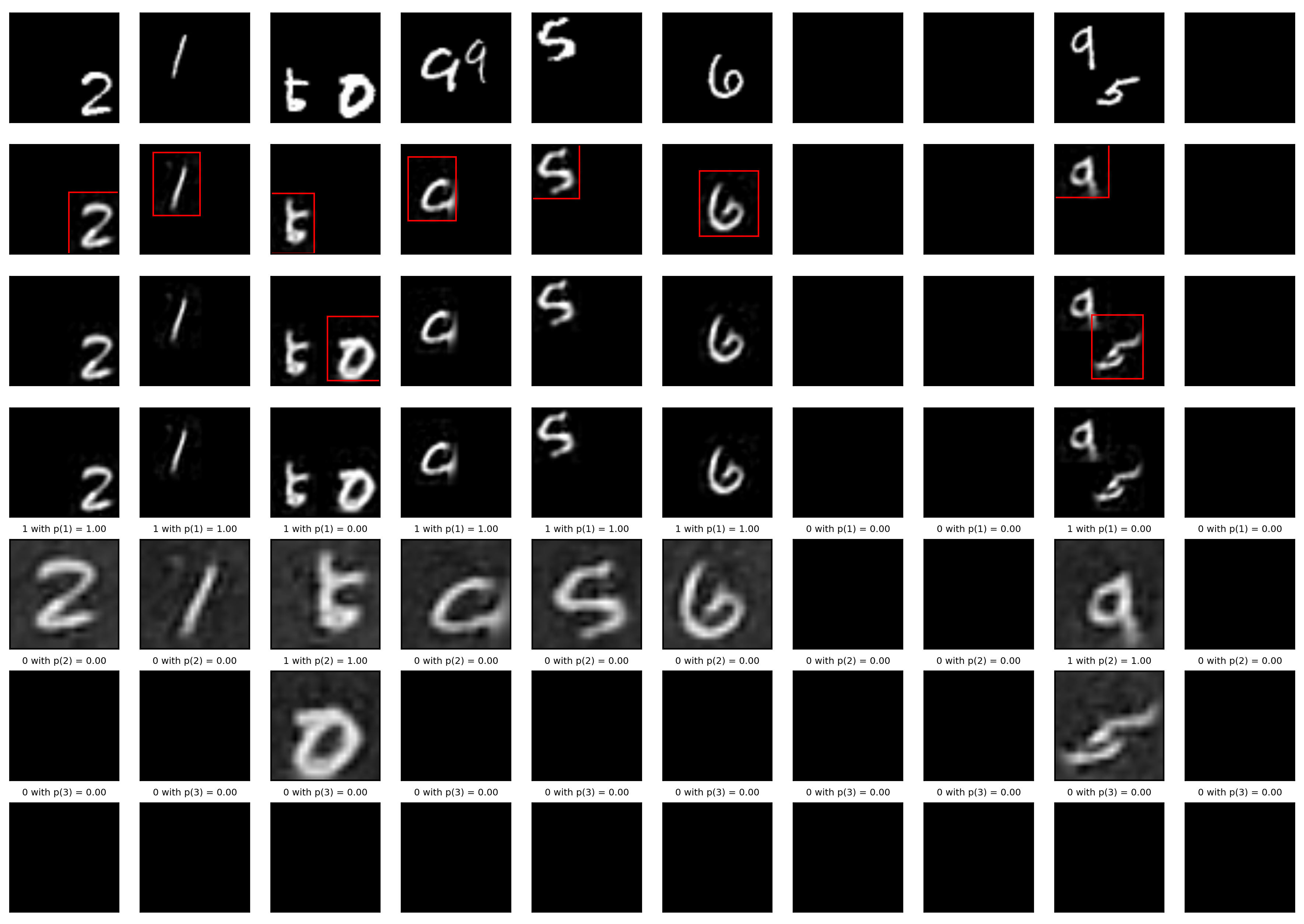
AIR learns to reconstruct objects by painting them one by one in a blank canvas. The below figure comes from a model trained for 175k iterations; the maximum number of steps is set to 3, but there are never more than 2 objects. The first row shows the input images, rows 2-4 are reconstructions at steps 1, 2 and 3 (with marked location of the attention glimpse in red, if it exists). Rows 4-7 are the reconstructed image crops, and above each crop is the probability of executing 1, 2 or 3 steps. If the reconstructed crop is black and there is "0 with ..." written above it, it means that this step was not used.
AIR results

Data

Run ./scripts/create_dataset.sh The script creates train and validation datasets of multi-digit MNIST.

Training

Run ./scripts/train_multi_mnist.sh The training script will run for 300k iteratios and will save model checkpoints and training progress figures every 10k iterations in results/multi_mnist. Tensorflow summaries are also stored in the same folder and Tensorboard can be used for monitoring.

The model seems to be very sensitive to initialisation. It might be necessary to run training multiple times before achieving count step accuracy close to the one reported in the paper.

Experimentation

The jupyter notebook available at attend_infer_repeat/experiment.ipynb can be used for experimentation.

Citation

If you find this repo useful in your research, please consider citing the original paper:

@incollection{Eslami2016,
    title = {Attend, Infer, Repeat: Fast Scene Understanding with Generative Models},
    author = {Eslami, S. M. Ali and Heess, Nicolas and Weber, Theophane and Tassa, Yuval and Szepesvari, David and kavukcuoglu, koray and Hinton, Geoffrey E},
    booktitle = {Advances in Neural Information Processing Systems 29},
    editor = {D. D. Lee and M. Sugiyama and U. V. Luxburg and I. Guyon and R. Garnett},
    pages = {3225--3233},
    year = {2016},
    publisher = {Curran Associates, Inc.},
    url = {http://papers.nips.cc/paper/6230-attend-infer-repeat-fast-scene-understanding-with-generative-models.pdf}
}

License

This program is free software; you can redistribute it and/or modify it under the terms of the GNU General Public License as published by the Free Software Foundation; either version 3 of the License, or (at your option) any later version.

This program is distributed in the hope that it will be useful, but WITHOUT ANY WARRANTY; without even the implied warranty of MERCHANTABILITY or FITNESS FOR A PARTICULAR PURPOSE. See the GNU General Public License for more details.

You should have received a copy of the GNU General Public License along with this program. If not, see http://www.gnu.org/licenses/.

Release Notes

Version 1.0

  • Original unofficial implementation; contains the multi-digit MNIST experiment.
Owner
Adam Kosiorek
I'm a PhD student at the Oxford Robotics Institute. I work on Machine Learning for perception - I'm looking into external memory and attention for RNNs.
Adam Kosiorek
Face Detection and Alignment using Multi-task Cascaded Convolutional Networks (MTCNN)

Face-Detection-with-MTCNN Face detection is a computer vision problem that involves finding faces in photos. It is a trivial problem for humans to sol

Chetan Hirapara 3 Oct 07, 2022
PyTorch implementation of Advantage async actor-critic Algorithms (A3C) in PyTorch

Advantage async actor-critic Algorithms (A3C) in PyTorch @inproceedings{mnih2016asynchronous, title={Asynchronous methods for deep reinforcement lea

LEI TAI 111 Dec 08, 2022
Tracking Progress in Question Answering over Knowledge Graphs

Tracking Progress in Question Answering over Knowledge Graphs Table of contents Question Answering Systems with Descriptions The QA Systems Table cont

Knowledge Graph Question Answering 47 Jan 02, 2023
Deep learning for spiking neural networks

A deep learning library for spiking neural networks. Norse aims to exploit the advantages of bio-inspired neural components, which are sparse and even

Electronic Vision(s) Group — BrainScaleS Neuromorphic Hardware 59 Nov 28, 2022
Implementation of Graph Convolutional Networks in TensorFlow

Graph Convolutional Networks This is a TensorFlow implementation of Graph Convolutional Networks for the task of (semi-supervised) classification of n

Thomas Kipf 6.6k Dec 30, 2022
This repository contains an implementation of the Permutohedral Attention Module in Pytorch

Permutohedral_attention_module This repository contains an implementation of the Permutohedral Attention Module

Samuel JOUTARD 26 Nov 27, 2022
Datasets, Transforms and Models specific to Computer Vision

torchvision The torchvision package consists of popular datasets, model architectures, and common image transformations for computer vision. Installat

13.1k Jan 02, 2023
Code repo for EMNLP21 paper "Zero-Shot Information Extraction as a Unified Text-to-Triple Translation"

Zero-Shot Information Extraction as a Unified Text-to-Triple Translation Source code repo for paper Zero-Shot Information Extraction as a Unified Text

cgraywang 88 Dec 31, 2022
Spectral normalization (SN) is a widely-used technique for improving the stability and sample quality of Generative Adversarial Networks (GANs)

Why Spectral Normalization Stabilizes GANs: Analysis and Improvements [paper (NeurIPS 2021)] [paper (arXiv)] [code] Authors: Zinan Lin, Vyas Sekar, Gi

Zinan Lin 32 Dec 16, 2022
Implementation of EMNLP 2017 Paper "Natural Language Does Not Emerge 'Naturally' in Multi-Agent Dialog" using PyTorch and ParlAI

Language Emergence in Multi Agent Dialog Code for the Paper Natural Language Does Not Emerge 'Naturally' in Multi-Agent Dialog Satwik Kottur, José M.

Karan Desai 105 Nov 25, 2022
Zero-shot Synthesis with Group-Supervised Learning (ICLR 2021 paper)

GSL - Zero-shot Synthesis with Group-Supervised Learning Figure: Zero-shot synthesis performance of our method with different dataset (iLab-20M, RaFD,

Andy_Ge 62 Dec 21, 2022
MetaTTE: a Meta-Learning Based Travel Time Estimation Model for Multi-city Scenarios

MetaTTE: a Meta-Learning Based Travel Time Estimation Model for Multi-city Scenarios This is the official TensorFlow implementation of MetaTTE in the

morningstarwang 4 Dec 14, 2022
Hippocampal segmentation using the UNet network for each axis

Hipposeg Hippocampal segmentation using the UNet network for each axis, inspired by https://github.com/MICLab-Unicamp/e2dhipseg Red: False Positive Gr

Juan Carlos Aguirre Arango 0 Sep 02, 2021
Scripts for training an AI to play the endless runner Subway Surfers using a supervised machine learning approach by imitation and a convolutional neural network (CNN) for image classification

About subwAI subwAI - a project for training an AI to play the endless runner Subway Surfers using a supervised machine learning approach by imitation

82 Jan 01, 2023
Auxiliary data to the CHIIR paper Searching to Learn with Instructional Scaffolding

Searching to Learn with Instructional Scaffolding This is the data and analysis code for the paper "Searching to Learn with Instructional Scaffolding"

Arthur Câmara 2 Mar 02, 2022
An official source code for "Augmentation-Free Self-Supervised Learning on Graphs"

Augmentation-Free Self-Supervised Learning on Graphs An official source code for Augmentation-Free Self-Supervised Learning on Graphs paper, accepted

Namkyeong Lee 59 Dec 01, 2022
Use unsupervised and supervised learning to predict stocks

AIAlpha: Multilayer neural network architecture for stock return prediction This project is meant to be an advanced implementation of stacked neural n

Vivek Palaniappan 1.5k Jan 06, 2023
Generating Videos with Scene Dynamics

Generating Videos with Scene Dynamics This repository contains an implementation of Generating Videos with Scene Dynamics by Carl Vondrick, Hamed Pirs

Carl Vondrick 706 Jan 04, 2023
Implementation of Vaswani, Ashish, et al. "Attention is all you need."

Attention Is All You Need Paper Implementation This is my from-scratch implementation of the original transformer architecture from the following pape

Brando Koch 195 Dec 30, 2022
An open-source outlier detection package by Getcontact Data Team

pyfbad The pyfbad library supports anomaly detection projects. An end-to-end anomaly detection application can be written using the source codes of th

Teknasyon Tech 41 Dec 27, 2022