

Summarization, translation, sentiment-analysis, text-generation and more at blazing speed using a T5 version implemented in ONNX.

Overview

ONNX T5 Actions Status Actions Status Version Downloads Slack

Summarization, translation, Q&A, text generation and more at blazing speed using a T5 version implemented in ONNX.

This package is still in alpha stage, therefore some functionalities such as beam searches are still in development.

Installation

ONNX-T5 is available on PyPi.

pip install onnxt5

For the dev version you can run the following.

git clone https://github.com/abelriboulot/onnxt5
cd onnxt5
pip install -e .

Usage

The simplest way to get started for generation is to use the default pre-trained version of T5 on ONNX included in the package.

NOTE: Please note that the first time you call get_encoder_decoder_tokenizer, the models are being downloaded which might take a minute or two.

from onnxt5 import GenerativeT5
from onnxt5.api import get_encoder_decoder_tokenizer
decoder_sess, encoder_sess, tokenizer = get_encoder_decoder_tokenizer()
generative_t5 = GenerativeT5(encoder_sess, decoder_sess, tokenizer, onnx=True)
prompt = 'translate English to French: I was a victim of a series of accidents.'

output_text, output_logits = generative_t5(prompt, max_length=100, temperature=0.)
# output_text: "J'ai été victime d'une série d'accidents."

Other tasks just require to change the prefix in your prompt, for instance for summarization:

prompt = 'summarize: <PARAGRAPH>'
output_text, output_logits = generative_t5(prompt, max_length=100, temperature=0.)

If you want to get the embeddings of text, you can run the following

from onnxt5.api import get_encoder_decoder_tokenizer, run_embeddings_text

decoder_sess, encoder_sess, tokenizer = get_encoder_decoder_tokenizer()
prompt = 'Listen, Billy Pilgrim has come unstuck in time.'
encoder_embeddings, decoder_embeddings = run_embeddings_text(encoder_sess, decoder_sess, tokenizer, prompt)

ONNXT5 also lets you export and use your own models. See the examples\ folder for more detailed examples.

T5 works with tokens such as summarize:, translate English to German:, or question: ... context:. You can see a list of the pretrained tasks and token in the appendix D of the original paper.

Functionalities

  • Run any of the T5 trained tasks in a line (translation, summarization, sentiment analysis, completion, generation)
  • Export your own T5 models to ONNX easily
  • Utility functions to generate what you need quickly
  • Up to 4X speedup compared to PyTorch execution for smaller contexts

Benchmarks

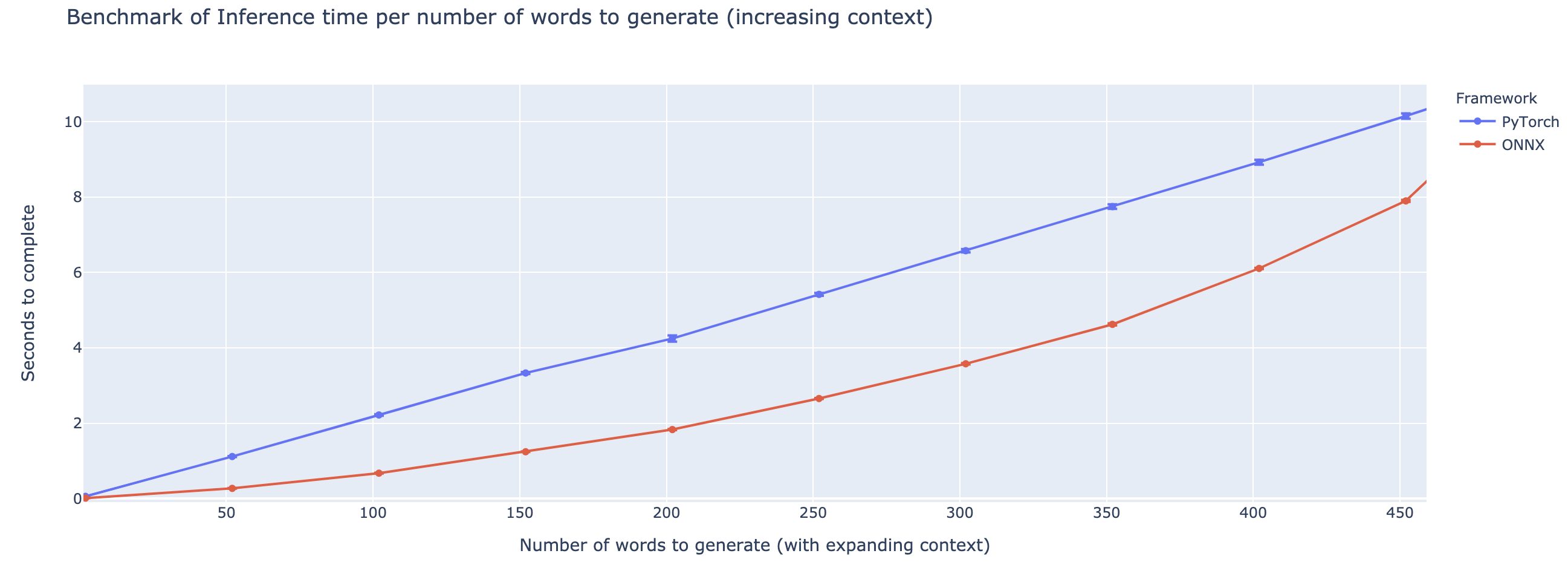
The outperformance varies heavily based on the length of the context. For contexts less than ~500 words, ONNX outperforms greatly, going up to a 4X speedup compared to PyTorch. However, the longer the context, the smaller the speedup of ONNX, with Pytorch being faster above 500 words.

GPU Benchmark, Embedding Task

Benchmark Embedding

GPU Benchmark, Generation Task

Benchmark Generation

Contributing

The project is still in its infancy, so I would love your feedback, to know what problems you are trying to solve, hear issues you're encountering, and discuss features that would help you. Therefore feel free to shoot me an e-mail (see my profile for the address!) or join our slack community.

Acknowledgements

This repo is based on the work of Colin Raffel and Noam Shazeer and Adam Roberts and Katherine Lee and Sharan Narang and Michael Matena and Yanqi Zhou and Wei Li and Peter J. Liu from Google, as well as the implementation of T5 from the huggingface team, the work of the Microsoft ONNX and onnxruntime teams, in particular Tianlei Wu, and the work of Thomas Wolf on generation of text.

Original T5 Paper

@article{2019t5,
  author = {Colin Raffel and Noam Shazeer and Adam Roberts and Katherine Lee and Sharan Narang and Michael Matena and Yanqi Zhou and Wei Li and Peter J. Liu},
  title = {Exploring the Limits of Transfer Learning with a Unified Text-to-Text Transformer},
  journal = {arXiv e-prints},
  year = {2019},
  archivePrefix = {arXiv},
  eprint = {1910.10683},
}

Microsoft onnxruntime repo

HuggingFace implementation of T5

Comments
  •  Given model could not be parsed while creating inference session. Error message: Protobuf parsing failed.

    Given model could not be parsed while creating inference session. Error message: Protobuf parsing failed.

    Hi there, I've run a guide code and it doesn't work. image I'm getting an error on the following line, decoder_sess, encoder_sess, tokenizer = get_encoder_decoder_tokenizer()

    image text is a text from Wikipedia about cars.

    onnxt5==0.1.4 protobuf==3.6.0 python==3.7

    opened by vladislavkoz 6
  • Default T5 summary contains <extra_id_2>.<extra_id_3>.<extra_id_4>

    Default T5 summary contains ..

    <extra_id_0> the company<extra_id_1> the company<extra_id_2>.<extra_id_3>.<extra_id_4>.<extra_id_5>.<extra_id_6>. <extra_id_7>.

    Do I need some postprocessing? Or it is an issue?

    opened by vladislavkoz 5
  • int() argument must be a string , when running exemple.

    int() argument must be a string , when running exemple.

    Hello , i can't run the first exemple ,

    from onnxt5 import GenerativeT5
    from onnxt5.api import get_encoder_decoder_tokenizer
    
    decoder_sess, encoder_sess, tokenizer = get_encoder_decoder_tokenizer()
    generative_t5 = GenerativeT5(encoder_sess, decoder_sess, tokenizer, onnx=True)
    prompt = 'translate English to French: I was a victim of a series of accidents.'
    
    output_text, output_logits = generative_t5(prompt, max_length=100, temperature=0.)
     # output_text: "J'ai été victime d'une série d'accidents." 
    

    the model begin calculation but before End, i have this error :

    TypeError                                 Traceback (most recent call last)
    <ipython-input-1-257f12b63043> in <module>
          5 prompt = 'translate English to French: I was a victim of a series of accidents.'
          6 
    ----> 7 output_text, output_logits = generative_t5(prompt, max_length=16, temperature=0.)
          8 # output_text: "J'ai été victime d'une série d'accidents."
    
    ~\Anaconda3\envs\onnxt5\lib\site-packages\torch\nn\modules\module.py in _call_impl(self, *input, **kwargs)
        720             result = self._slow_forward(*input, **kwargs)
        721         else:
    --> 722             result = self.forward(*input, **kwargs)
        723         for hook in itertools.chain(
        724                 _global_forward_hooks.values(),
    
    ~\Anaconda3\envs\onnxt5\lib\site-packages\onnxt5\models.py in forward(self, prompt, max_length, temperature, repetition_penalty, top_k, top_p, max_context_length)
        145                 new_tokens.append(next_token)
        146 
    --> 147             return self.tokenizer.decode(new_tokens), new_logits
    
    ~\Anaconda3\envs\onnxt5\lib\site-packages\transformers\tokenization_utils_base.py in decode(self, token_ids, skip_special_tokens, clean_up_tokenization_spaces, **kwargs)
       3000             skip_special_tokens=skip_special_tokens,
       3001             clean_up_tokenization_spaces=clean_up_tokenization_spaces,
    -> 3002             **kwargs,
       3003         )
       3004 
    
    ~\Anaconda3\envs\onnxt5\lib\site-packages\transformers\tokenization_utils.py in _decode(self, token_ids, skip_special_tokens, clean_up_tokenization_spaces, spaces_between_special_tokens)
        730         spaces_between_special_tokens: bool = True,
        731     ) -> str:
    --> 732         filtered_tokens = self.convert_ids_to_tokens(token_ids, skip_special_tokens=skip_special_tokens)
        733 
        734         # To avoid mixing byte-level and unicode for byte-level BPT
    
    ~\Anaconda3\envs\onnxt5\lib\site-packages\transformers\tokenization_utils.py in convert_ids_to_tokens(self, ids, skip_special_tokens)
        708         tokens = []
        709         for index in ids:
    --> 710             index = int(index)
        711             if skip_special_tokens and index in self.all_special_ids:
        712                 continue
    
    TypeError: int() argument must be a string, a bytes-like object or a number, not 'list
    

    `

    and i have no idea how to find solution , if you have any solution !? thx !

    opened by AZE38 3
  • Inference time on gpu vs onnxt5-gpu

    Inference time on gpu vs onnxt5-gpu

    @abelriboulot , @Ki6an , @brymck .
    I have finetuned t5 model for paraphrasing task like this: Paraphrase with t5

    I want to reduce inference time, so I exported finetuned t5 model using onnxt5, here I get time taken more in case where I use onnx model on gpu than pytorch model on gpu.

    gpu: time taken = 0.2357314471155405 time taken = 0.24958523781970143 time taken = 0.20342689706012607 time taken = 0.5490081580355763 time taken = 0.10756197292357683

    onnxt5-gpu time taken = 0.5277913622558117 time taken = 0.6335883080027997 time taken = 0.6975196991115808 time taken = 1.9159171842038631 time taken = 0.7938353712670505

    Did I make mistake in exporting/loading model ? gpu code onnxt5-gpu code

    opened by priyanksonis 1
  • Add progress bar

    Add progress bar

    This adds a progress bar using tqdm.

    The files this library downloads are about 500 MB in size, so I'd like to have some feedback on what's happening. Originally I wasn't clear what was the cause of the delay when running get_encoder_decoder_tokenizer.

    opened by brymck 0
  • Add download progress bar

    Add download progress bar

    This adds a progress bar using tqdm.

    The files this library downloads are about 500 MB in size, so I'd like to have some feedback on what's happening. Originally I wasn't clear what was the cause of the delay when running get_encoder_decoder_tokenizer.

    opened by brymck 0
  • CVE-2007-4559 Patch

    CVE-2007-4559 Patch

    Patching CVE-2007-4559

    Hi, we are security researchers from the Advanced Research Center at Trellix. We have began a campaign to patch a widespread bug named CVE-2007-4559. CVE-2007-4559 is a 15 year old bug in the Python tarfile package. By using extract() or extractall() on a tarfile object without sanitizing input, a maliciously crafted .tar file could perform a directory path traversal attack. We found at least one unsantized extractall() in your codebase and are providing a patch for you via pull request. The patch essentially checks to see if all tarfile members will be extracted safely and throws an exception otherwise. We encourage you to use this patch or your own solution to secure against CVE-2007-4559. Further technical information about the vulnerability can be found in this blog.

    If you have further questions you may contact us through this projects lead researcher Kasimir Schulz.

    opened by TrellixVulnTeam 0
  • Add dtype to new_tokens tensor to avoid an error when decoding

    Add dtype to new_tokens tensor to avoid an error when decoding

    Thanks for the repo!

    I was having an error message come up when running the code after my initial install.

    Small code example:

    import os
    
    import torch
    from onnxt5 import GenerativeT5
    from onnxt5.api import get_sess
    from transformers import AutoTokenizer
    
    model_dir = <path-to-tokenizer-and-onnx-files>
    model_name = <name-of-model>
    
    tokenizer = AutoTokenizer.from_pretrained(
        model_dir,
    )
    
    decoder_sess, encoder_sess = get_sess(
        os.path.join(model_dir, model_name)
    )
    
    model = GenerativeT5(
        encoder_sess,
        decoder_sess,
        tokenizer,
        onnx=True,
        cuda=torch.cuda.is_available(),
    )
    
    sentences = [
        "I has good grammar.",
        "I have bettr grammur."
    ]
    
    corrected_sentences = [
        model(f"grammar: {sentence}",
              max_length=512,
              temperature=1,
              )[0]
        for sentence in sentences
    ]


    The error

    Traceback (most recent call last):
      File "/Users/jamiebrandon/Code/inferentia-test/onnx_example/compiled-t5-base-grammar-correction/code/inference.py", line 133, in <module>
        main()
      File "/Users/jamiebrandon/Code/inferentia-test/onnx_example/compiled-t5-base-grammar-correction/code/inference.py", line 125, in main
        prediction_output = predict_fn(input_data=input_tokens,
      File "/Users/jamiebrandon/Code/inferentia-test/onnx_example/compiled-t5-base-grammar-correction/code/inference.py", line 95, in predict_fn
        corrected_sentences = [model(f"grammar: {sentence}",
      File "/Users/jamiebrandon/Code/inferentia-test/onnx_example/compiled-t5-base-grammar-correction/code/inference.py", line 95, in <listcomp>
        corrected_sentences = [model(f"grammar: {sentence}",
      File "/Users/jamiebrandon/Code/inferentia-test/venv/lib/python3.9/site-packages/torch/nn/modules/module.py", line 1130, in _call_impl
        return forward_call(*input, **kwargs)
      File "/Users/jamiebrandon/Code/inferentia-test/onnx_example/compiled-t5-base-grammar-correction/onnxt5/onnxt5/models.py", line 154, in forward
        return self.tokenizer.decode(new_tokens), new_logits
      File "/Users/jamiebrandon/Code/inferentia-test/venv/lib/python3.9/site-packages/transformers/tokenization_utils_base.py", line 3367, in decode
        return self._decode(
      File "/Users/jamiebrandon/Code/inferentia-test/venv/lib/python3.9/site-packages/transformers/tokenization_utils_fast.py", line 548, in _decode
        text = self._tokenizer.decode(token_ids, skip_special_tokens=skip_special_tokens)
    TypeError: 'float' object cannot be interpreted as an integer
    

    It seems the tensor for new tokens is of type float instead of long. Adding dtype=torch.long to the instantiation of the tensor resolved my issue, so I thought I'd share.

    opened by jambran 0
  • Running example

    Running example "export_pretrained_model.py" as-is fails (See details)

    86%|████████▌ | 18/21 [00:00<00:00, 44.29it/s]
    ---------------------------------------------------------------------------
    TypeError                                 Traceback (most recent call last)
    <ipython-input-4-f543e3365977> in <module>()
         27 # Generating text
         28 generative_t5 = GenerativeT5(encoder_sess, decoder_sess, tokenizer, onnx=True)
    ---> 29 generative_t5('translate English to French: I was a victim of a series of accidents.', 21, temperature=0.)[0]
    
    3 frames
    /usr/local/lib/python3.7/dist-packages/transformers/tokenization_utils_fast.py in _decode(self, token_ids, skip_special_tokens, clean_up_tokenization_spaces, **kwargs)
        505         if isinstance(token_ids, int):
        506             token_ids = [token_ids]
    --> 507         text = self._tokenizer.decode(token_ids, skip_special_tokens=skip_special_tokens)
        508 
        509         if clean_up_tokenization_spaces:
    
    TypeError: 'float' object cannot be interpreted as an integer
    

    Any possible version conflicts that you know of?

    opened by PrithivirajDamodaran 2
  • How to suppress output

    How to suppress output

    How to suppress output? Setting verbosity logging level does nothing 5%|█████████▊ | 16/300 [00:01<00:18, 15.65it/s]

    opened by 127 0
  • Can this model suitable for multilingual-t5 accelerate?

    Can this model suitable for multilingual-t5 accelerate?

    Recently, I use the chinese function of multilingual-t5 model to accomplish the Chinese NLG tasks. However, the inference speed might be slow, could this model be used for multilingual-t5? How can I do?

    opened by williamwong91 2
Releases(0.1.9)
Owner
Abel
Repentant portfolio manager, turned data scientist. I'm one Vonnegut quote away from figuring out this whole life thing.
Abel
Web Scraping, Document Deduplication & GPT-2 Fine-tuning with a newly created scam dataset.

Web Scraping, Document Deduplication & GPT-2 Fine-tuning with a newly created scam dataset.

18 Nov 28, 2022
Use fastai-v2 with HuggingFace's pretrained transformers

FastHugs Use fastai v2 with HuggingFace's pretrained transformers, see the notebooks below depending on your task: Text classification: fasthugs_seq_c

Morgan McGuire 111 Nov 16, 2022
NLP Core Library and Model Zoo based on PaddlePaddle 2.0

PaddleNLP 2.0拥有丰富的模型库、简洁易用的API与高性能的分布式训练的能力,旨在为飞桨开发者提升文本建模效率,并提供基于PaddlePaddle 2.0的NLP领域最佳实践。

6.9k Jan 01, 2023
🤕 spelling exceptions builder for lazy people

🤕 spelling exceptions builder for lazy people

Vlad Bokov 3 May 12, 2022
Topic Inference with Zeroshot models

zeroshot_topics Table of Contents Installation Usage License Installation zeroshot_topics is distributed on PyPI as a universal wheel and is available

Rita Anjana 55 Nov 28, 2022
Tevatron is a simple and efficient toolkit for training and running dense retrievers with deep language models.

Tevatron Tevatron is a simple and efficient toolkit for training and running dense retrievers with deep language models. The toolkit has a modularized

texttron 193 Jan 04, 2023
The proliferation of disinformation across social media has led the application of deep learning techniques to detect fake news.

Fake News Detection Overview The proliferation of disinformation across social media has led the application of deep learning techniques to detect fak

Kushal Shingote 1 Feb 08, 2022
A Paper List for Speech Translation

Keyword: Speech Translation, Spoken Language Processing, Natural Language Processing

138 Dec 24, 2022
Code to reprudece NeurIPS paper: Accelerated Sparse Neural Training: A Provable and Efficient Method to Find N:M Transposable Masks

Accelerated Sparse Neural Training: A Provable and Efficient Method to FindN:M Transposable Masks Recently, researchers proposed pruning deep neural n

itay hubara 4 Feb 23, 2022
Google's Meena transformer chatbot implementation

Here's my attempt at recreating Meena, a state of the art chatbot developed by Google Research and described in the paper Towards a Human-like Open-Domain Chatbot.

Francesco Pham 94 Dec 25, 2022
An open source library for deep learning end-to-end dialog systems and chatbots.

DeepPavlov is an open-source conversational AI library built on TensorFlow, Keras and PyTorch. DeepPavlov is designed for development of production re

Neural Networks and Deep Learning lab, MIPT 6k Dec 30, 2022
Implementation of COCO-LM, Correcting and Contrasting Text Sequences for Language Model Pretraining, in Pytorch

COCO LM Pretraining (wip) Implementation of COCO-LM, Correcting and Contrasting Text Sequences for Language Model Pretraining, in Pytorch. They were a

Phil Wang 44 Jul 28, 2022
Hierarchical unsupervised and semi-supervised topic models for sparse count data with CorEx

Anchored CorEx: Hierarchical Topic Modeling with Minimal Domain Knowledge Correlation Explanation (CorEx) is a topic model that yields rich topics tha

Greg Ver Steeg 592 Dec 18, 2022
Korean Simple Contrastive Learning of Sentence Embeddings using SKT KoBERT and kakaobrain KorNLU dataset

KoSimCSE Korean Simple Contrastive Learning of Sentence Embeddings implementation using pytorch SimCSE Installation git clone https://github.com/BM-K/

34 Nov 24, 2022
translate using your voice

speech-to-text-translator Usage translate using your voice description this project makes translating a word easy, all you have to do is speak and...

1 Oct 18, 2021
Ray-based parallel data preprocessing for NLP and ML.

Wrangl Ray-based parallel data preprocessing for NLP and ML. pip install wrangl # for latest pip install git+https://github.com/vzhong/wrangl See exa

Victor Zhong 33 Dec 27, 2022
100+ Chinese Word Vectors 上百种预训练中文词向量

Chinese Word Vectors 中文词向量 中文 This project provides 100+ Chinese Word Vectors (embeddings) trained with different representations (dense and sparse),

embedding 10.4k Jan 09, 2023
中文問句產生器;使用台達電閱讀理解資料集(DRCD)

Transformer QG on DRCD The inputs of the model refers to we integrate C and A into a new C' in the following form. C' = [c1, c2, ..., [HL], a1, ..., a

Philip 1 Oct 22, 2021
Jarvis is a simple Chatbot with a GUI capable of chatting and retrieving information and daily news from the internet for it's user.

J.A.R.V.I.S Kindly consider starring this repository if you like the program :-) What/Who is J.A.R.V.I.S? J.A.R.V.I.S is an chatbot written that is bu

Epicalable 50 Dec 31, 2022
Use the power of GPT3 to execute any function inside your programs just by giving some doctests

gptrun Don't feel like coding today? Use the power of GPT3 to execute any function inside your programs just by giving some doctests. How is this diff

Roberto Abdelkader Martínez Pérez 11 Nov 11, 2022