Kata: Clean Machine Learning From Dirty Code
First, open the Kata in Google Colab (or else download it)
You can clone this project and launch jupyter-notebook, or use the files in Google Colab here:
You may want to do File > Save a copy in Drive... in Colab to edit your own copy of the file.
Kata 1: Refactor Dirty ML Code into Pipeline
Let's convert dirty machine learning code into clean code using a Pipeline - which is the Pipe and Filter Design Pattern for Machine Learning.
At first you may still wonder why using this Design Patterns is good. You'll realize just how good it is in the 2nd Clean Machine Learning Kata when you'll do AutoML. Pipelines will give you the ability to easily manage the hyperparameters and the hyperparameter space, on a per-step basis. You'll also have the good code structure for training, saving, reloading, and deploying using any library you want without hitting a wall when it'll come to serializing your whole trained pipeline for deploying in prod.
The Dataset
It'll be downloaded automatically for you in the code below.
We're using a Human Activity Recognition (HAR) dataset captured using smartphones. The dataset can be found on the UCI Machine Learning Repository.
The task
Classify the type of movement amongst six categories from the phones' sensor data:
- WALKING,
- WALKING_UPSTAIRS,
- WALKING_DOWNSTAIRS,
- SITTING,
- STANDING,
- LAYING.
Video dataset overview
Follow this link to see a video of the 6 activities recorded in the experiment with one of the participants:
[Watch video]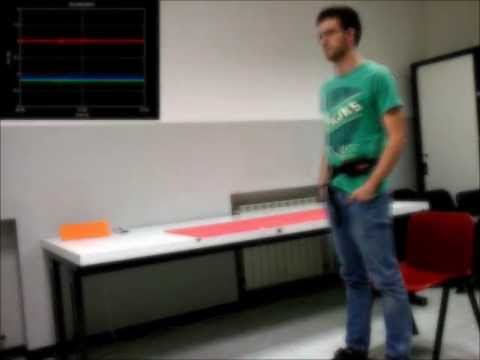
Details about the input data
The dataset's description goes like this:
The sensor signals (accelerometer and gyroscope) were pre-processed by applying noise filters and then sampled in fixed-width sliding windows of 2.56 sec and 50% overlap (128 readings/window). The sensor acceleration signal, which has gravitational and body motion components, was separated using a Butterworth low-pass filter into body acceleration and gravity. The gravitational force is assumed to have only low frequency components, therefore a filter with 0.3 Hz cutoff frequency was used.
Reference:
Davide Anguita, Alessandro Ghio, Luca Oneto, Xavier Parra and Jorge L. Reyes-Ortiz. A Public Domain Dataset for Human Activity Recognition Using Smartphones. 21th European Symposium on Artificial Neural Networks, Computational Intelligence and Machine Learning, ESANN 2013. Bruges, Belgium 24-26 April 2013.
That said, I will use the almost raw data: only the gravity effect has been filtered out of the accelerometer as a preprocessing step for another 3D feature as an input to help learning. If you'd ever want to extract the gravity by yourself, you could use the following Butterworth Low-Pass Filter (LPF) and edit it to have the right cutoff frequency of 0.3 Hz which is a good frequency for activity recognition from body sensors.
Here is how the 3D data cube looks like. So we'll have a train and a test data cube, and might create validation data cubes as well:

So we have 3D data of shape [batch_size, time_steps, features]. If this and the above is still unclear to you, you may want to learn more on the 3D shape of time series data.
Loading the Dataset
import urllib
import os

def download_import(filename):
    with open(filename, "wb") as f:
        # Downloading like that is needed because of Colab operating from a Google Drive folder that is only "shared with you".
        url = 'https://raw.githubusercontent.com/Neuraxio/Kata-Clean-Machine-Learning-From-Dirty-Code/master/{}'.format(filename)
        f.write(urllib.request.urlopen(url).read())

try:
    import google.colab
    download_import("data_loading.py")
    !mkdir data;
    download_import("data/download_dataset.py")
    print("Downloaded .py files: dataset loaders.")
except:
    print("No dynamic .py file download needed: not in a Colab.")

DATA_PATH = "data/"
!pwd && ls
os.chdir(DATA_PATH)
!pwd && ls
!python download_dataset.py
!pwd && ls
os.chdir("..")
!pwd && ls
DATASET_PATH = DATA_PATH + "UCI HAR Dataset/"
print("\n" + "Dataset is now located at: " + DATASET_PATH)
# install neuraxle if needed:
try:
    import neuraxle
    assert neuraxle.__version__ == '0.3.4'
except:
    !pip install neuraxle==0.3.4
# Finally load dataset!
from data_loading import load_all_data
X_train, y_train, X_test, y_test = load_all_data()
print("Dataset loaded!")
Let's now define and execute our ugly code:
You don't need to change the functions here just below. We'll rather code this again after in the next section.
import numpy as np
from sklearn.metrics import accuracy_score
from sklearn.tree import DecisionTreeClassifier


def get_fft_peak_infos(real_fft, time_bins_axis=-2):
    """
    Extract the indices of the bins with maximal amplitude, and the corresponding amplitude values.

    :param fft: real magnitudes of an fft. It could be of shape [N, bins, features].
    :param time_bins_axis: axis of the frequency bins (e.g.: time axis before fft).
    :return: Two arrays without bins. One is an int, the other is a float. Shape: ([N, features], [N, features])
    """
    peak_bin = np.argmax(real_fft, axis=time_bins_axis)
    peak_bin_val = np.max(real_fft, axis=time_bins_axis)
    return peak_bin, peak_bin_val


def fft_magnitudes(data_inputs, time_axis=-2):
    """
    Apply a Fast Fourier Transform operation to analyze frequencies, and return real magnitudes.
    The bins past the half (past the nyquist frequency) are discarded, which result in shorter time series.

    :param data_inputs: ND array of dimension at least 1. For instance, this could be of shape [N, time_axis, features]
    :param time_axis: axis along which the time series evolve
    :return: real magnitudes of the data_inputs. For instance, this could be of shape [N, (time_axis / 2) + 1, features]
             so here, we have `bins = (time_axis / 2) + 1`.
    """
    fft = np.fft.rfft(data_inputs, axis=time_axis)
    real_fft = np.absolute(fft)
    return real_fft


def get_fft_features(x_data):
    """
    Will featurize data with an FFT.

    :param x_data: 3D time series of shape [batch_size, time_steps, sensors]
    :return: featurized time series with FFT of shape [batch_size, features]
    """
    real_fft = fft_magnitudes(x_data)
    flattened_fft = real_fft.reshape(real_fft.shape[0], -1)
    peak_bin, peak_bin_val = get_fft_peak_infos(real_fft)
    return flattened_fft, peak_bin, peak_bin_val


def featurize_data(x_data):
    """
    Will convert 3D time series of shape [batch_size, time_steps, sensors] to shape [batch_size, features]
    to prepare data for machine learning.

    :param x_data: 3D time series of shape [batch_size, time_steps, sensors]
    :return: featurized time series of shape [batch_size, features]
    """
    print("Input shape before feature union:", x_data.shape)

    flattened_fft, peak_bin, peak_bin_val = get_fft_features(x_data)
    mean = np.mean(x_data, axis=-2)
    median = np.median(x_data, axis=-2)
    min = np.min(x_data, axis=-2)
    max = np.max(x_data, axis=-2)

    featurized_data = np.concatenate([
        flattened_fft,
        peak_bin,
        peak_bin_val,
        mean,
        median,
        min,
        max,
    ], axis=-1)

    print("Shape after feature union, before classification:", featurized_data.shape)
    return featurized_data
Let's now use the ugly code to do ugly machine learning with it.
Fit:
# Shape: [batch_size, time_steps, sensor_features]
X_train_featurized = featurize_data(X_train)
# Shape: [batch_size, remade_features]

classifier = DecisionTreeClassifier()
classifier.fit(X_train_featurized, y_train)
Predict:
# Shape: [batch_size, time_steps, sensor_features]
X_test_featurized = featurize_data(X_test)
# Shape: [batch_size, remade_features]

y_pred = classifier.predict(X_test_featurized)
print("Shape at output after classification:", y_pred.shape)
# Shape: [batch_size]
Eval:
accuracy = accuracy_score(y_pred=y_pred, y_true=y_test)
print("Accuracy of ugly pipeline code:", accuracy)
Cleaning Up: Define Pipeline Steps and a Pipeline
The kata is to fill the classes below and to use them properly in the pipeline thereafter.
There are some missing classes as well that you should define.
from neuraxle.base import BaseStep, NonFittableMixin
from neuraxle.steps.numpy import NumpyConcatenateInnerFeatures, NumpyShapePrinter, NumpyFlattenDatum

class NumpyFFT(NonFittableMixin, BaseStep):
    def transform(self, data_inputs):
        """
        Featurize time series data with FFT.

        :param data_inputs: time series data of 3D shape: [batch_size, time_steps, sensors_readings]
        :return: featurized data is of 2D shape: [batch_size, n_features]
        """
        transformed_data = np.fft.rfft(data_inputs, axis=-2)
        return transformed_data


class FFTPeakBinWithValue(NonFittableMixin, BaseStep):
    def transform(self, data_inputs):
        """
        Will compute peak fft bins (int), and their magnitudes' value (float), to concatenate them.

        :param data_inputs: real magnitudes of an fft. It could be of shape [batch_size, bins, features].
        :return: Two arrays without bins concatenated on feature axis. Shape: [batch_size, 2 * features]
        """
        time_bins_axis = -2
        peak_bin = np.argmax(data_inputs, axis=time_bins_axis)
        peak_bin_val = np.max(data_inputs, axis=time_bins_axis)

        # Notice that here another FeatureUnion could have been used with a joiner:
        transformed = np.concatenate([peak_bin, peak_bin_val], axis=-1)

        return transformed


class NumpyMedian(NonFittableMixin, BaseStep):
    def transform(self, data_inputs):
        """
        Will featurize data with a median.

        :param data_inputs: 3D time series of shape [batch_size, time_steps, sensors]
        :return: featurized time series of shape [batch_size, features]
        """
        return np.median(data_inputs, axis=-2)


class NumpyMean(NonFittableMixin, BaseStep):
    def transform(self, data_inputs):
        """
        Will featurize data with a mean.

        :param data_inputs: 3D time series of shape [batch_size, time_steps, sensors]
        :return: featurized time series of shape [batch_size, features]
        """
        raise NotImplementedError("TODO")
        return ...
Let's now create the Pipeline with the code:
from neuraxle.base import Identity
from neuraxle.pipeline import Pipeline
from neuraxle.steps.flow import TrainOnlyWrapper
from neuraxle.union import FeatureUnion

pipeline = Pipeline([
    # ToNumpy(),  # Cast type in case it was a list.
    # For debugging, do this print at train-time only:
    TrainOnlyWrapper(NumpyShapePrinter(custom_message="Input shape before feature union")),
    # Shape: [batch_size, time_steps, sensor_features]
    FeatureUnion([
        # TODO in kata 1: Fill the classes in this FeatureUnion here and make them work.
        #      Note that you may comment out some of those feature classes
        #      temporarily and reactivate them one by one.
        Pipeline([
            NumpyFFT(),
            NumpyAbs(),  # do `np.abs` here.
            FeatureUnion([
                NumpyFlattenDatum(),  # Reshape from 3D to flat 2D: flattening data except on batch size
                FFTPeakBinWithValue()  # Extract 2D features from the 3D FFT bins
            ], joiner=NumpyConcatenateInnerFeatures())
        ]),
        NumpyMean(),
        NumpyMedian(),
        NumpyMin(),
        NumpyMax()
    ], joiner=NumpyConcatenateInnerFeatures()),  # The joiner will here join like this: np.concatenate([...], axis=-1)
    # TODO, optional: Add some feature selection right here for the motivated ones:
    #      https://scikit-learn.org/stable/modules/feature_selection.html
    TrainOnlyWrapper(NumpyShapePrinter(custom_message="Shape after feature union, before classification")),
    # Shape: [batch_size, remade_features]
    # TODO: use an `Inherently multiclass` classifier here from:
    #       https://scikit-learn.org/stable/modules/multiclass.html
    YourClassifier(),
    TrainOnlyWrapper(NumpyShapePrinter(custom_message="Shape at output after classification")),
    # Shape: [batch_size]
    Identity()
])
Test Your Code: Make the Tests Pass
The 3rd test is the real deal.
def _test_is_pipeline(pipeline):
    assert isinstance(pipeline, Pipeline)


def _test_has_all_data_preprocessors(pipeline):
    assert "DecisionTreeClassifier" in pipeline
    assert "FeatureUnion" in pipeline
    assert "Pipeline" in pipeline["FeatureUnion"]
    assert "NumpyMean" in pipeline["FeatureUnion"]
    assert "NumpyMedian" in pipeline["FeatureUnion"]
    assert "NumpyMin" in pipeline["FeatureUnion"]
    assert "NumpyMax" in pipeline["FeatureUnion"]


def _test_pipeline_words_and_has_ok_score(pipeline):
    pipeline = pipeline.fit(X_train, y_train)

    y_pred = pipeline.predict(X_test)

    accuracy = accuracy_score(y_test, y_pred)
    print("Test accuracy score:", accuracy)
    assert accuracy > 0.7


if __name__ == '__main__':
    tests = [_test_is_pipeline, _test_has_all_data_preprocessors, _test_pipeline_words_and_has_ok_score]
    for t in tests:
        try:
            t(pipeline)
            print("==> Test '{}(pipeline)' succeed!".format(t.__name__))
        except Exception as e:
            print("==> Test '{}(pipeline)' failed:".format(t.__name__))
            import traceback
            print(traceback.format_exc())
Good job!
Your code should now be clean after making the tests pass.
You're ready for the Kata 2.
You should now be ready for the 2nd Clean Machine Learning Kata. Note that the solutions are available in the repository above as well. You may use the links to the Google Colab files to try to solve the Katas.
Recommended additional readings and learning resources:
- For more info on clean machine learning, you may want to read How to Code Neat Machine Learning Pipelines.
- For reaching higher performances, you could use a LSTM Recurrent Neural Network and refactoring it into a neat pipeline as you've created here, now by using TensorFlow in your ML pipeline.
- You may as well want to request more training and coaching for your ML or time series processing projects from us if you need.

 1.3k Dec 31, 2022
 15 Nov 20, 2022
 1 Dec 10, 2021
 5 Dec 01, 2022
 6 Oct 04, 2022
 520 Jan 04, 2023
 800 Dec 05, 2022
 137 Nov 09, 2022
 122 Dec 07, 2022
 21 Mar 03, 2022
 348 Dec 25, 2022
 10 May 03, 2022
 38 Dec 12, 2022
 14 May 25, 2022
 232 Dec 24, 2022
 12 Jan 02, 2023
 2 Aug 05, 2022
 1.3k Dec 21, 2022
 178 Dec 13, 2022
 34 Dec 08, 2022