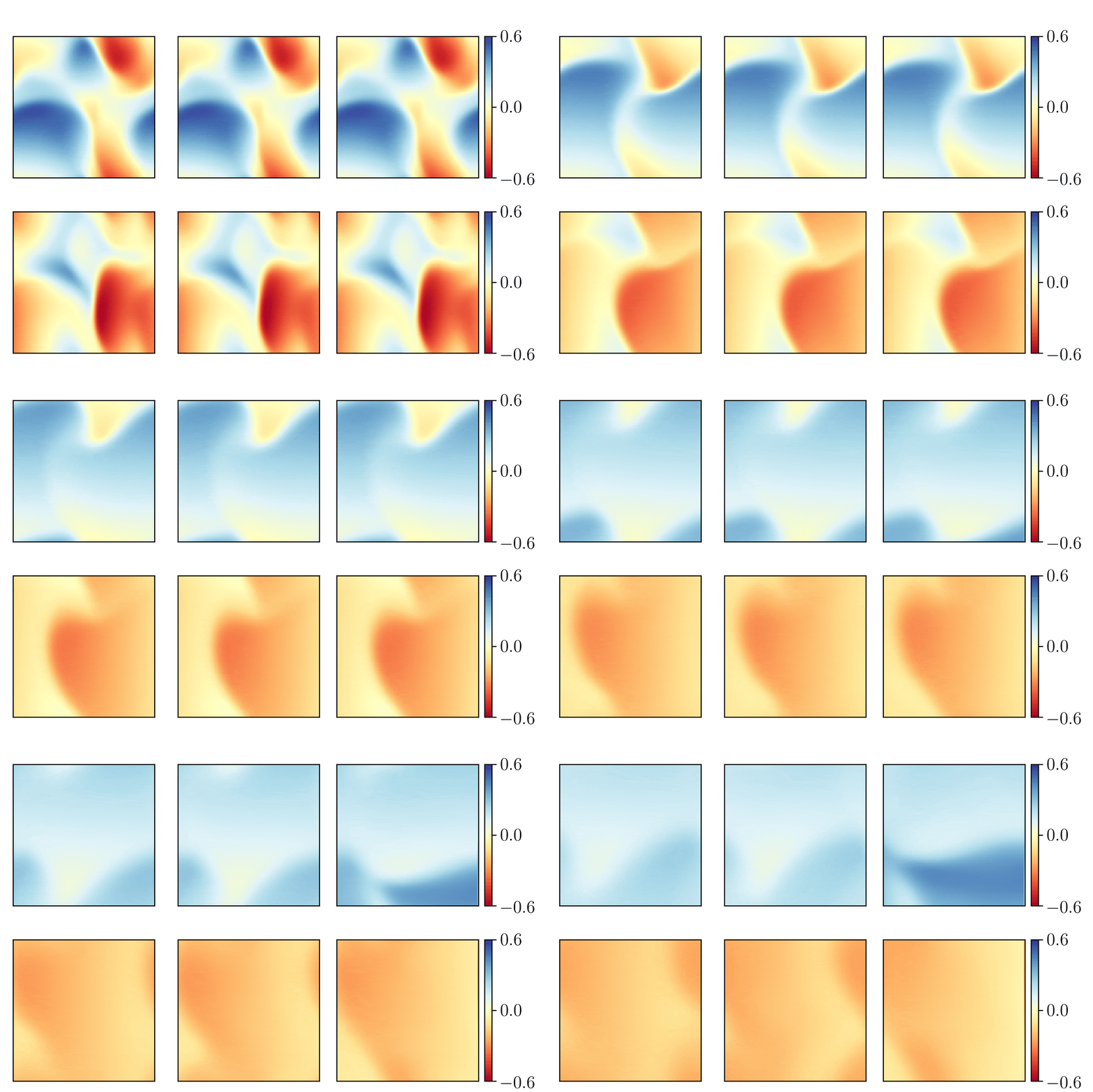
PyTorch code for Composing Partial Differential Equations with Physics-Aware Neural Networks

Related tags

Deep Learningfinn
Overview

FInite volume Neural Network (FINN)

This repository contains the PyTorch code for models, training, and testing, and Python code for data generation to conduct the experiments as reported in the work Composing Partial Differential Equations with Physics-Aware Neural Networks

If you find this repository helpful, please cite our work:

@article{karlbauer2021composing,
	author    = {Karlbauer, Matthias and Praditia, Timothy and Otte, Sebastian and Oladyshkin, Sergey and Nowak, Wolfgang and Butz, Martin V},
	title     = {Composing Partial Differential Equations with Physics-Aware Neural Networks},
	journal   = {arXiv preprint arXiv:2111.11798},
	year      = {2021},
}

Dependencies

We recommend setting up an (e.g. conda) environment with python 3.7 (i.e. conda create -n finn python=3.7). The required packages for data generation and model evaluation are

  • conda install -c anaconda numpy scipy
  • conda install -c pytorch pytorch==1.9.0
  • conda install -c jmcmurray json
  • conda install -c conda-forge matplotlib torchdiffeq jsmin

Models & Experiments

The code of the different pure machine learning models (TCN, ConvLSTM, DISTANA) and physics-aware models (PINN, PhyDNet, FINN) can be found in the models directory.

Each model directory contains a config.json file to specify model parameters, data, etc. Please modify the sections in the respective config.json files as detailed below (further information about data and model architectures is reported in the according data sections of the paper's appendices):

"training": {
	"t_stop": 150  // burger and allen-cahn 150, diff-sorp 400, diff-react 70
},

"validation": {
	"t_start": 150,  // burger and allen-cahn 150, diff-sorp 400, diff-react 70
	"t_stop": 200  // burger and allen-cahn 200, diff-sorp 500, diff-react 100
},

"data": {
	"type": "burger",  // "burger", "diffusion_sorption", "diffusion_reaction", "allen_cahn"
	"name": "data_ext",  // "data_train", "data_ext", "data_test"
}

"model": {
  	"name": "burger"  // "burger", "diff-sorp", "diff-react", "allen-cahn"
	"field_size": [49],  // burger and allen-cahn [49], diff-sorp [26], fhn [49, 49]
	... other settings to be specified according to the model architectures section in the paper's appendix
}

The actual models can be trained and tested by calling the according python train.py or python test.py scripts. Alternatively, python experiment.py can be used to either train or test n models (please consider the settings in the experiment.py script).

Data generation

The Python scripts to generate the burger, diffusion-sorption, diffusion-reaction, and allen-cahn data can be found in the data directory.

In each of the burger, diffusion_sorption, diffusion_reaction, and allen-cahn directories, a data_generation.py and simulator.py script can be found. The former is used to generate train, extrapolation (ext), or test data. For details about the according data generation settings of each dataset, please refer to the corresponding data sections in the paper's appendices.

You might also like...
Official implementation for the paper:
Official implementation for the paper: "Multi-label Classification with Partial Annotations using Class-aware Selective Loss"

Multi-label Classification with Partial Annotations using Class-aware Selective Loss Paper | Pretrained models Official PyTorch Implementation Emanuel

Must-read Papers on Physics-Informed Neural Networks.

PINNpapers Contributed by IDRL lab. Introduction Physics-Informed Neural Network (PINN) has achieved great success in scientific computing since 2017.

Physics-informed convolutional-recurrent neural networks for solving spatiotemporal PDEs

PhyCRNet Physics-informed convolutional-recurrent neural networks for solving spatiotemporal PDEs Paper link: [ArXiv] By: Pu Ren, Chengping Rao, Yang

 Physics-Aware Training (PAT) is a method to train real physical systems with backpropagation.
Physics-Aware Training (PAT) is a method to train real physical systems with backpropagation.

Physics-Aware Training (PAT) is a method to train real physical systems with backpropagation. It was introduced in Wright, Logan G. & Onodera, Tatsuhiro et al. (2021)1 to train Physical Neural Networks (PNNs) - neural networks whose building blocks are physical systems.

Pytorch Implementation of Interaction Networks for Learning about Objects, Relations and Physics

Interaction-Network-Pytorch Pytorch Implementraion of Interaction Networks for Learning about Objects, Relations and Physics. Interaction Network is a

IDRLnet, a Python toolbox for modeling and solving problems through Physics-Informed Neural Network (PINN) systematically.

IDRLnet IDRLnet is a machine learning library on top of PyTorch. Use IDRLnet if you need a machine learning library that solves both forward and inver

PINN(s): Physics-Informed Neural Network(s) for von Karman vortex street

PINN(s): Physics-Informed Neural Network(s) for von Karman vortex street This is

Implementation of "Scaled-YOLOv4: Scaling Cross Stage Partial Network" using PyTorch framwork.

YOLOv4-large This is the implementation of "Scaled-YOLOv4: Scaling Cross Stage Partial Network" using PyTorch framwork. YOLOv4-CSP YOLOv4-tiny YOLOv4-

Unofficial pytorch implementation of 'Image Inpainting for Irregular Holes Using Partial Convolutions'

pytorch-inpainting-with-partial-conv Official implementation is released by the authors. Note that this is an ongoing re-implementation and I cannot f

Releases(v1.0.0)
  • v1.0.0(Oct 28, 2022)

    This release contains the PyTorch code for models, training, and testing, and Python code for data generation to conduct the experiments.

    Source code(tar.gz)
    Source code(zip)
Owner
Cognitive Modeling
The chair of Cognitive Modeling addresses the question: "How does the mind work?", pursuing an integrative, interdisciplinary, computational approach.
Cognitive Modeling
Masked regression code - Masked Regression

Masked Regression MR - Python Implementation This repositery provides a python implementation of MR (Masked Regression). MR can efficiently synthesize

Arbish Akram 1 Dec 23, 2021
[3DV 2021] Channel-Wise Attention-Based Network for Self-Supervised Monocular Depth Estimation

Channel-Wise Attention-Based Network for Self-Supervised Monocular Depth Estimation This is the official implementation for the method described in Ch

Jiaxing Yan 27 Dec 30, 2022
This repository contains the official implementation code of the paper Transformer-based Feature Reconstruction Network for Robust Multimodal Sentiment Analysis

This repository contains the official implementation code of the paper Transformer-based Feature Reconstruction Network for Robust Multimodal Sentiment Analysis, accepted at ACMMM 2021.

Ziqi Yuan 10 Sep 30, 2022
Detail-Preserving Transformer for Light Field Image Super-Resolution

DPT Official Pytorch implementation of the paper "Detail-Preserving Transformer for Light Field Image Super-Resolution" accepted by AAAI 2022 . Update

50 Jan 01, 2023
VLG-Net: Video-Language Graph Matching Networks for Video Grounding

VLG-Net: Video-Language Graph Matching Networks for Video Grounding Introduction Official repository for VLG-Net: Video-Language Graph Matching Networ

Mattia Soldan 25 Dec 04, 2022
Dirty Pixels: Towards End-to-End Image Processing and Perception

Dirty Pixels: Towards End-to-End Image Processing and Perception This repository contains the code for the paper Dirty Pixels: Towards End-to-End Imag

50 Nov 18, 2022
Pytorch implementation of AngularGrad: A New Optimization Technique for Angular Convergence of Convolutional Neural Networks

AngularGrad Optimizer This repository contains the oficial implementation for AngularGrad: A New Optimization Technique for Angular Convergence of Con

mario 124 Sep 16, 2022
People Interaction Graph

Gihan Jayatilaka*, Jameel Hassan*, Suren Sritharan*, Janith Senananayaka, Harshana Weligampola, et. al., 2021. Holistic Interpretation of Public Scenes Using Computer Vision and Temporal Graphs to Id

University of Peradeniya : COVID Research Group 1 Aug 24, 2022
Code for HLA-Face: Joint High-Low Adaptation for Low Light Face Detection (CVPR21)

HLA-Face: Joint High-Low Adaptation for Low Light Face Detection The official PyTorch implementation for HLA-Face: Joint High-Low Adaptation for Low L

Wenjing Wang 77 Dec 08, 2022
PyTorch code of paper "LiVLR: A Lightweight Visual-Linguistic Reasoning Framework for Video Question Answering"

LiVLR-VideoQA We propose a Lightweight Visual-Linguistic Reasoning framework (LiVLR) for VideoQA. The overview of LiVLR: Evaluation on MSRVTT-QA Datas

JJ Jiang 7 Dec 30, 2022
Certifiable Outlier-Robust Geometric Perception

Certifiable Outlier-Robust Geometric Perception About This repository holds the implementation for certifiably solving outlier-robust geometric percep

83 Dec 31, 2022
Cycle Consistent Adversarial Domain Adaptation (CyCADA)

Cycle Consistent Adversarial Domain Adaptation (CyCADA) A pytorch implementation of CyCADA. If you use this code in your research please consider citi

Hyunwoo Ko 2 Jan 10, 2022
A deep learning network built with TensorFlow and Keras to classify gender and estimate age.

Convolutional Neural Network (CNN). This repository contains a source code of a deep learning network built with TensorFlow and Keras to classify gend

Pawel Dziemiach 1 Dec 18, 2021
AFLNet: A Greybox Fuzzer for Network Protocols

AFLNet: A Greybox Fuzzer for Network Protocols AFLNet is a greybox fuzzer for protocol implementations. Unlike existing protocol fuzzers, it takes a m

626 Jan 06, 2023
Train CPPNs as a Generative Model, using Generative Adversarial Networks and Variational Autoencoder techniques to produce high resolution images.

cppn-gan-vae tensorflow Train Compositional Pattern Producing Network as a Generative Model, using Generative Adversarial Networks and Variational Aut

hardmaru 343 Dec 29, 2022
Data, notebooks, and articles associated with the RSNA AI Deep Learning Lab at RSNA 2021

RSNA AI Deep Learning Lab 2021 Intro Welcome Deep Learners! This document provides all the information you need to participate in the RSNA AI Deep Lea

RSNA 65 Dec 16, 2022
EZ graph is an easy to use AI solution that allows you to make and train your neural networks without a single line of code.

EZ-Graph EZ Graph is a GUI that allows users to make and train neural networks without writing a single line of code. Requirements python 3 pandas num

1 Jul 03, 2022
Python implementation of "Single Image Haze Removal Using Dark Channel Prior"

##Dependencies pillow(~2.6.0) Numpy(~1.9.0) If the scripts throw AttributeError: __float__, make sure your pillow has jpeg support e.g. try: $ sudo ap

Joyee Cheung 73 Dec 20, 2022
Continuous Query Decomposition for Complex Query Answering in Incomplete Knowledge Graphs

Continuous Query Decomposition This repository contains the official implementation for our ICLR 2021 (Oral) paper, Complex Query Answering with Neura

UCL Natural Language Processing 71 Dec 29, 2022
Repo for parser tensorflow(.pb) and tflite(.tflite)

tfmodel_parser .pb file is the format of tensorflow model .tflite file is the format of tflite model, which usually used in mobile devices before star

1 Dec 23, 2021